|
Kyoto & Nara, Japan
Sunday, June 4, 2017 |
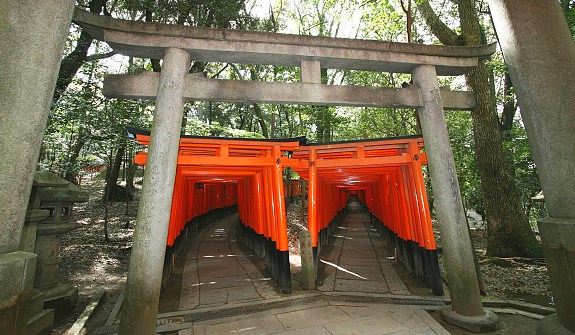
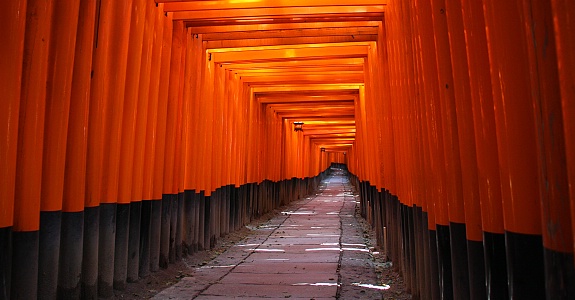
After breakfast, we began our day with a tour of Kyoto’s spiritual landmarks. Our first stop took us up the path of 10,000 red torii gates leading to the Fushimi Inari Shrine.
A special Blessing Ceremony had been arranged for us and we were given etched wooden blocks by the High priest. Walking up through the tori gates was a cool experience.
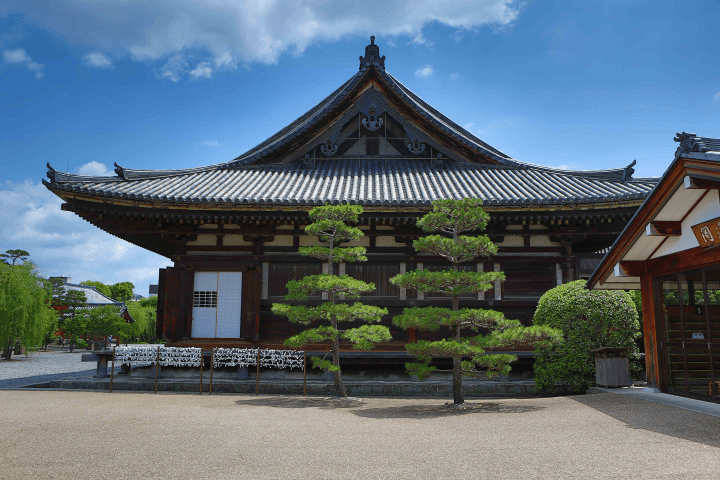
Next we toured Sanjūsangen-dō, a Buddhist temple features a huge hall that displays 1,001 statues of Kannon that were carved in the 12th and 13th century. The temple almost resembles an old fashioned wooden train station from the outside. The temple was very crowded and once again lots of school groups touring the area.
For lunch we enjoyed Shabu-Shabu at a local restaurant.
After lunch we visited the Noh Theater for an educational presentation and a performance. It was very interesting.
This evening we had a private cocktail hour in a temple garden and then walked to a restaurant in the Gion district for dinner. During dinner we were entertained by a Maiko, (a young apprenctice dancer) who was 18, and two Geikos.
KYOTO
Kyoto (京都, Kyōto) served as Japan’s capital and the emporer’s residence from 794 until 1868. It is now the country’s seventh largest city with a population of 1.4 million people. Over the centuries, Kyoto was destroyed by many wars and fires, but due to its historic value, the city was dropped from the list of target cities for the atomic bomb and spared from air raids during World War II. Kyoto is famous worldwide for its temples and shrines and was the center of politics and culture for 1,100 years.
NOH THEATER was registered in 2008 as an Intangible Cultural Heritage of Unesco. It originated in the 14h century. Noh is a major form of classical Japanese musical drama performed exclusively by men with recitative chants (called “Yokyoku”) and a small orchestra (a flute and 3 drums only) accompanying the play. It is unique in its slow grace and its use of elaborate masks. Here, the stage meets the strict architectural rules of the genre that unites aesthetics and technique. Cedar wood floors that cover ceramic urns are supported by four pillars with a roof similar to that of a sanctuary. The urns are necessary to enhancing the sounds created by the actors feet. A bridge (hashigakari) is a symbolic passage for the lead actor to enter from backstage. Very few stage settings are used although there is always a pine tree painted on the back wall of the stage. The theater was originally an outdoor structure but a house has now been built around it. The costumes are quite heavy and were very uncomfortable in the heat of an outdoor setting.
Get a multifaceted look at Japanese culture and traditions, starting at a local
theater. From the ancient storylines and traditional masks, to the slow, trance-like
music and instruments, Noh theater has been a part of Japanese culture since the
14th century. After a demonstration and short performance, we are welcomed
into a nearby home for tea and a conversation about modern Japanese culture.
FUSHIMI INARI SHRINE
Fushimi Inari Shrine (伏見稲荷࣪ 3;社, Fushimi Inari Taisha) is an important Shinto Shrine in southern Kyoto. It is famous for its thousands of vermilion torii gates which straddle a network of trails behind its main buildings. The trails lead into the wooded forest of the sacred Mount Inari, which stands at 233 meters and belongs to the shrine grounds.Fushimi Inari is the most important of several thousands of shrines dedicated to Inari, the Shinto God of rice. Foxes are thought to be Inari’s messengers, resulting in many fox statues across the shrine grounds. Fushimi Inari Shrine has ancient origins, predating the capital’s move to Kyoto in 794.While the primary reason most foreign visitors come to Fushimi Inari Shrine is to explore the mountain trails, the shrine buildings themselves are also attractive and worth a visit. At the shrine’s entrance stands the Romon Gate, which was donated in 1589 by the famous leader Toyotomi Hideyoshi. Behind stands the shrine’s main building (Honden) and various auxiliary buildings.At the very back of the shrine’s main grounds is the entrance to the torii gate covered hiking trail, which starts with two dense, parallel rows of gates called Senbon Torii (“thousands of torii gates”). The torii gates along the entire trail are donations by individuals and companies, and you will find the donator’s name and the date of the donation inscribed on the back of each gate. The cost starts around 400,000 yen for a small sized gate and increases to over one million yen for a large gate.The hike to the summit of the mountain and back takes about 2-3 hours, however, visitors are free to walk just as far as they wish before turning back. Along the way, there are multiple smaller shrines with stacks of miniature torii gates that were donated by visitors with smaller budgets. There are also a few restaurants along the way, which offer locally themed dishes such as Inari Sushi and Kitsune Udon (“Fox Udon”), both featuring pieces of aburaage (fried tofu), said to be a favorite food of foxes. After about a 30-45 minute ascent and a gradual decrease in the density of torii gates, visitors will reach the Yotsutsuji intersection roughly half way up the mountain, where some nice views over Kyoto can be enjoyed, and the trail splits into a circular route to the summit. Many hikers only venture as far as here, as the trails do not offer much variation beyond this point and the gate density decreases further.
SANJUSANGENDO (Rengeo-in) TEMPLE
Sanjusangendo (Rengeo-in) Temple was originally built by Taira no Kiyamori for retired emperor Go-Shirakawa in 1164 and dedicated to the Bodhisattva Kannon. The original temple building was lost in a fire, but reconstructed in 1266. That structure has remained unchanged for 700 years since then with four great renovations during that time.
 D. Kauten's Travel Blog