|
Iceland to Greenland
Monday, June 19, 2017 |
We started out super early today. Wheelie bags to the Lobby by 5:30am and departure for the long drive to the international airport at 6:30am to get on the plane for our 8am departure to Greenland.
Depart: Reykjavík, Iceland 11:00 a.m.
Arrive: Kangerlussuaq, Greenland 11:05 a.m.
Elapsed Time: 2 hours, 5 min.
Arrived in Kangerlussuaq at 8:10am Greenland time. Absolutely NO passport or immigration process here. Gotta love that. Sadly, though, that meant there was no one there to stamp our passports. We hopped off our jet and directly onto the “buses” to do a bit of touring. There’s not much to this city, no cars on the road and no people visible anywhere. Feels like an episode of the Twilight Zone! We went to the Reindeer Ice Cap (90 min drive) to look for musk ox and reindeer and view the glacier. We spotted 2 white hair and 1 reindeer along the drive and a few musk ox. We had a picnic lunch in a tent in Kangerlussuaq. We drove around the local terrain passing time until our charter flight and then toured Kangerlusuaq museum. Yesterday there was an earthquake and tsunami in northern Greenland which has impacted our local charter flights. Many of the helicopters and fixed wing planes have been sent north to assist in the search and recovery mission. We’re divided into small groups for our flights to Ilulissat (we are in Group 3-sad!). This annoying group of travelers are going nuts about having to wait around! I’d like to pass out some Xanax! Thankfully, Nat Geo arranged for us to go up to the hotel bar and drink. Thank heaven! Jim and I shared 5 vodka’s (they pour really small drinks here!).
Finally arrived in Ilulissat around 8pm and got whisked through the airport in short order. Made it to the hotel just at the tail end of dinner-yet another mediocre buffet. They serve a LOT of whale here! We can see Dogsledding dogs tethered to their little houses in back of our hotel. Sadly, we’ve been told not to go pet them. 😦
Tonight we embarked on a Midnight Sun Cruise around Disko Bay through the icy waters to get close to the glacier’s edge and witness pieces breaking and crashing into the fjord. It was a stunning boat ride, albeit a cold and windy one. Jim got some great photo’s. Ilulissat abuts the massive Ilulissat Icefjord, the source of many of the icebergs in Greenlandic waters. We had an adorable young guide, Kristina, from Norway. She pulled up iceberg chunks and made us mixed drinks with the crushed iceberg ice using Martini & Rossi dry vermouth. When you put your glass to your ear you can hear the glacier cubes crackling as they release oxygen into the liquor.
Overnight: Hotel Arctic (so NOT a 4 star hotel as listed!!) 1 US Dollar= 6.65 Danish Krone
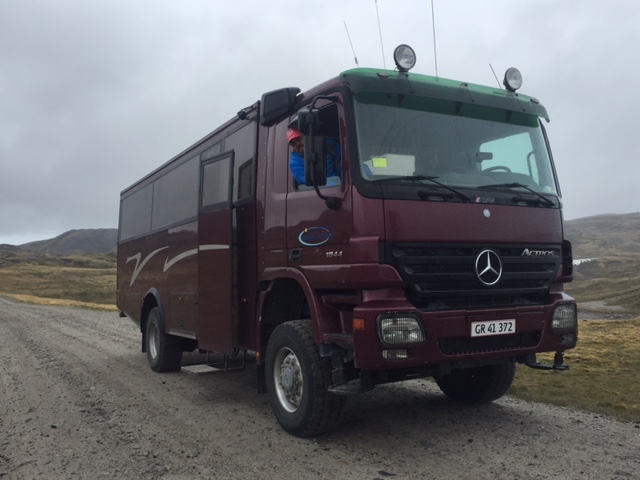
Jim in our big wheel traveler in “Kangaroo town”
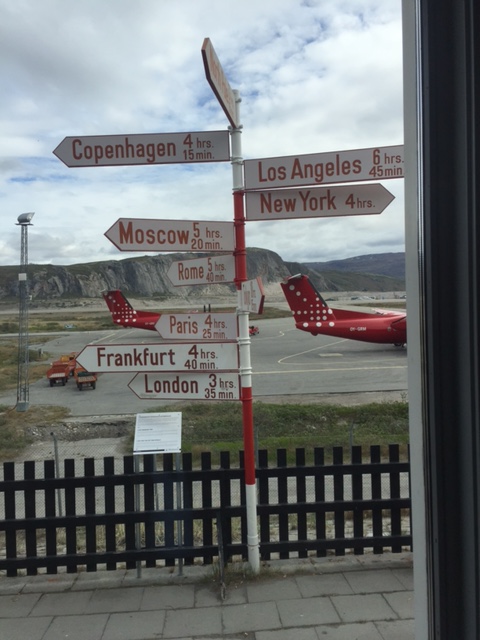
Love this sign at the Kangerlussuaq airport
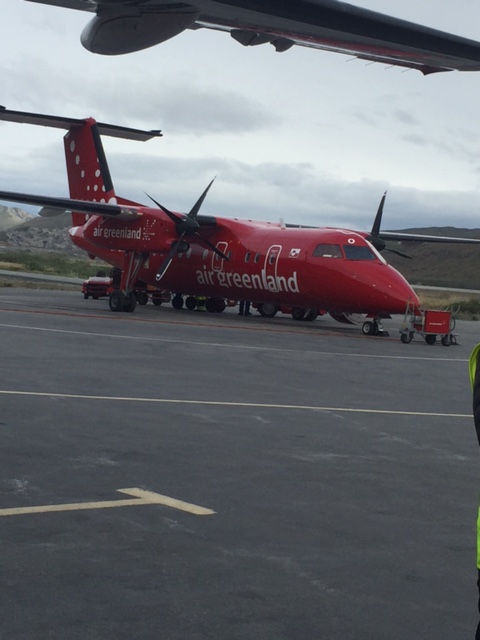
Our charter plane for the flight to Ilulissat
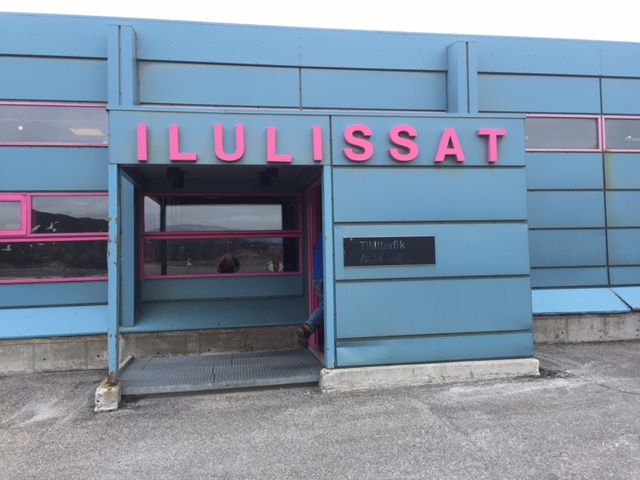
Finally arrived at Ilulissat airport

View from our hotel window. Icebergs everywhere!
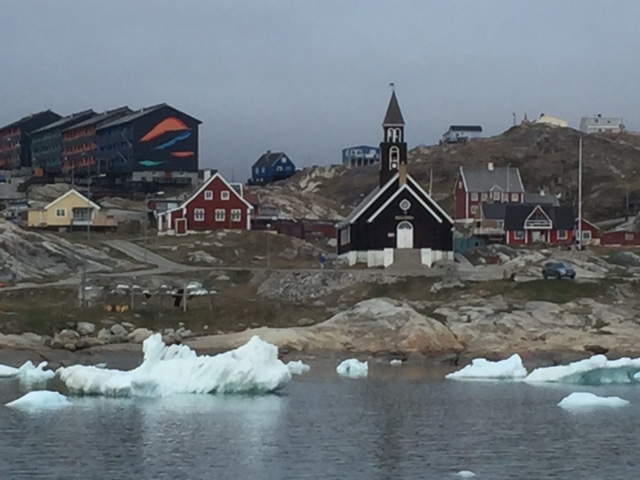
View of Ilulissat from the harbor as we depart on our Midnight Sun Cruise

Ilulissat from the water

Icebergs along the way on our cruise

Icebergs, Icebergs everywhere!
GREENLAND– 57,000 people live in Greenland. The literacy rate is 100%!
Kangerlussuaq is a town of about 500 residents in western Greenland founded as a military base during World War II and now a hub of scientific research. Kangerlussuaq airport is located on the far end of a 180 kilometre long fjord. The Ice Cap is located 25 kilometres from Kangerlussuaq. The scenery that you pass on your way there is quite varied – sometimes you will see green patches of grass on the one side of the car and small whirling tornadoes of sand like an Arctic dessert on the other side. Kangerlussuaq Airport is one of several old airports built by the Americans during either World War II or the cold war, which is still evident in the architecture despite several years of modernization. Many of the old military buildings are placed on a straight perpendicular line along the roads that still carry names testifying to the presence of the Americans. Although, the words ‘street’ or ‘road’ have now been replaced by the Greenlandic word ‘aqqutaa’. The American influence has also provided the small village with a bowling alley, a golf course on gravel and a cinema. Kangerlussuaq has a rich wildlife. The best-known species are probably the musk ox, the reindeer and the white fox. The animal population has reached 3,000-4,000.
ILULISSAT
Ilulissat was founded in 1741 as Jakobshavn. With approximately 4530 residents, it is the third largest town in Greenland. Ilulissat has 4 surrounding villages and 3500 sled dogs. Knud Rasmussen was born in Ilulissat, and his house is now a museum. Ilulissat means ‘icebergs’. Not one moment passes that you forget your proximity to the dynamic sculpture gallery of icebergs just outside town.
Even when you close your eyes, the icebergs’ soundtrack of cracking and rumbling echoes from one end of Ilulissat to the other. It is only after you have marveled at their chiseled shapes from the air, felt tiny while sailing past them on boat tours, and smelled their sweet scent while hiking along the UNESCO World Heritage Site that you can grasp the full character of Ilulissat’s icebergs.
-
Winter in Ilulissat means dog sledding – a favorite amongst all residents, human and canine. When the mercury rises too high, locals often make jokes by sniffling and sneezing as though they are sick. Ask them what ails them, and they will cheekily respond that they are allergic to summer! Just as the sled dogs are pulling at the chains at the first whiff of snow, the mushers also greatly anticipate the start of dog sledding season. The sled dogs energize the whole space, and you get a jolt of power as you sit on the sled for your personal Iditarod adventure. Sled dogs are just happy to run, and they pay no attention to whether their precious cargo is eager tourist or a stack of Greenlandic halibut. Centuries of pacing over thick sea ice and powdery terrain course through their blood so just hold on tight and let them carry you like they were born to do.
Ilulissat Icefjord located on the west coast of Greenland, 250 km north of the Arctic Circle, Greenland’s Ilulissat Icefjord (40,240 ha) is the sea mouth of Sermeq Kujalleq, one of the few glaciers through which the Greenland ice cap reaches the sea. Sermeq Kujalleq is one of the fastest (19 m per day) and most active glaciers in the world. It annually calves over 35 km3 of ice, i.e. 10% of the production of all Greenland calf ice and more than any other glacier outside Antarctica. Studied for over 250 years, it has helped to develop our understanding of climate change and icecap glaciology. The combination of a huge ice-sheet and the dramatic sounds of a fast-moving glacial ice-stream calving into a fjord covered by icebergs makes for a dramatic and awe-inspiring natural phenomenon.
Brief synthesis Located on the west coast of Greenland, 250 km north of the Arctic Circle, Greenland’s Ilulissat Icefjord is a tidal fjord covered with floating brash and massive ice, as it is situated where the Sermeq Kujalleq glacier calves ice into the sea. In winter, the area is frozen solid. One of the few places where ice from the Greenland ice cap enters the sea, Sermeq Kujalleq is also one of the fastest moving (40 m per day) and most active glaciers in the world. Its annual calving of over 46 cubic kilometres of ice, i.e. 10% of all Greenland calf ice, is more than any other glacier outside Antarctica, and it is still actively eroding the fjord bed. The combination of a huge ice-sheet and the dramatic sounds of a fast-moving glacial ice-stream calving into a fjord full of icebergs make for a dramatic and awe-inspiring natural phenomenon.The Greenland ice cap is the only remnant in the Northern Hemisphere of the continental ice sheets from the Quaternary Ice Age. The oldest ice is estimated to be 250,000 years old, and provides detailed information on past climatic changes and atmospheric conditions from 250,000 to around 11,550 years ago, when climate became more stable. Studies made over the last 250 years demonstrate that during the last ice age, the climate fluctuated between extremely cold and warmer periods, while today the ice cap is being maintained by an annual accumulation of snow that matches the loss through calving and melting at the margins. This phenomenon has helped to develop our understanding of climate change and icecap glaciology. Criterion (vii): The combination of a huge ice sheet and a fast moving glacial ice-stream calving into a fjord covered by icebergs is a phenomenon only seen in Greenland and Antarctica. Ilulissat offers both scientists and visitors easy access for a close view of the calving glacier front as it cascades down from the ice sheet and into the ice-choked fjord. The wild and highly scenic combination of rock, ice and sea, along with the dramatic sounds produced by the moving ice, combine to present a memorable natural spectacle. Criterion (viii): The Ilulissat Icefjord is an outstanding example of a stage in the Earth’s history: the last ice age of the Quaternary Period. The ice-stream is one of the fastest (40 m per day) and most active in the world. Its annual calving of over 46 km3 of ice accounts for 10% of the production of all Greenland calf ice, more than any other glacier outside Antarctica. The glacier has been the object of scientific attention for 250 years and, along with its relative ease of accessibility, has significantly added to the understanding of ice-cap glaciology, climate change and related geomorphic processes. IntegrityThe property is of sufficient size to adequately represent the geological process of the ice fjord, i.e. the fast-moving ice-stream, the relevant portion of the inland icecap, the glacial front and the fjord. The boundaries of the property are clearly defined in relation to the logical topographic criteria of the natural watershed, and the settlements of the nearby villages of Ilimanaq and Ilulissat are excluded from the property. Along with climatic limitations and the fact that no roads exist at the site, the area’s physical features retain a high degree of natural integrity.The property has effective legal protection and a sound planning framework, including the prohibition of any mining in the protected area. However, increased management will be required as pressures from tourism and resource harvesting continue to grow. Protection and management requirementsThe property is protected and conserved by an established framework of government legislation and protective designations and by local planning policies. The main legislative measure is the Greenland Parliament Act No. 29 of 18 December 2003 on nature protection. This act is the foundation framework for the protection of species, ecosystems and protected areas. Ilulissat itself is protected under the Greenland Home Rule Government Order No. 10 of 15 June 2007 on protection of Ilulissat Icefjord. The area bordering the property is further controlled by national regulations on waste disposal, use of snowmobiles, building constructions and landscape protection. Extensive hunting and fishing occurs in a portion of the property, and a special hunting law is enforced and monitored to ensure that the exploitation of biological resources in the area is sustainable. The property itself is managed cooperatively by a Board consisting of representatives from the Ministry of Environment and Nature and the Municipality of Ilulissat.A comprehensive management plan has been developed and the property will benefit from a monitoring programme. Particular attention was paid to the rapidly increasing tourism in the area, and in particular pressures emanating from cruise ships visiting the site and helicopter traffic. Regulations concerning visits to the property by boat, foot, helicopter and dog sledge; the management of waste and waste disposal; building constructions; exploitation of biological resources in the area, and protection of the cultural heritage sites within the property have been put into place. Signage and visitor infrastructure have been upgraded, and a visitor centre in the town of Ilulissat is planned. All land in the reserve is state-owned and no permanent settlements are allowed. Nearby construction is also strictly controlled. Visitor access to the area is limited by the wilderness character of the landscape, with no roads or human-made structures. Management issues such as crowding (from cruise tourism) and erosion are limited to a small area close to the town of Ilulissat. The protection of the property will be further enhanced when a planned buffer zone is adopted.
 D. Kauten's Travel Blog