Friday February 23rd, 2018 Sunrise: 0531/Sunset: 2025
The Weddell Sea, Tabular Bergs & Paulet Island
“We must always remember with gratitude and admiration the first sailors who steered their vessels through storms and mists and increased our knowledge of the lands of ice in the South.” –Roald Amundsen
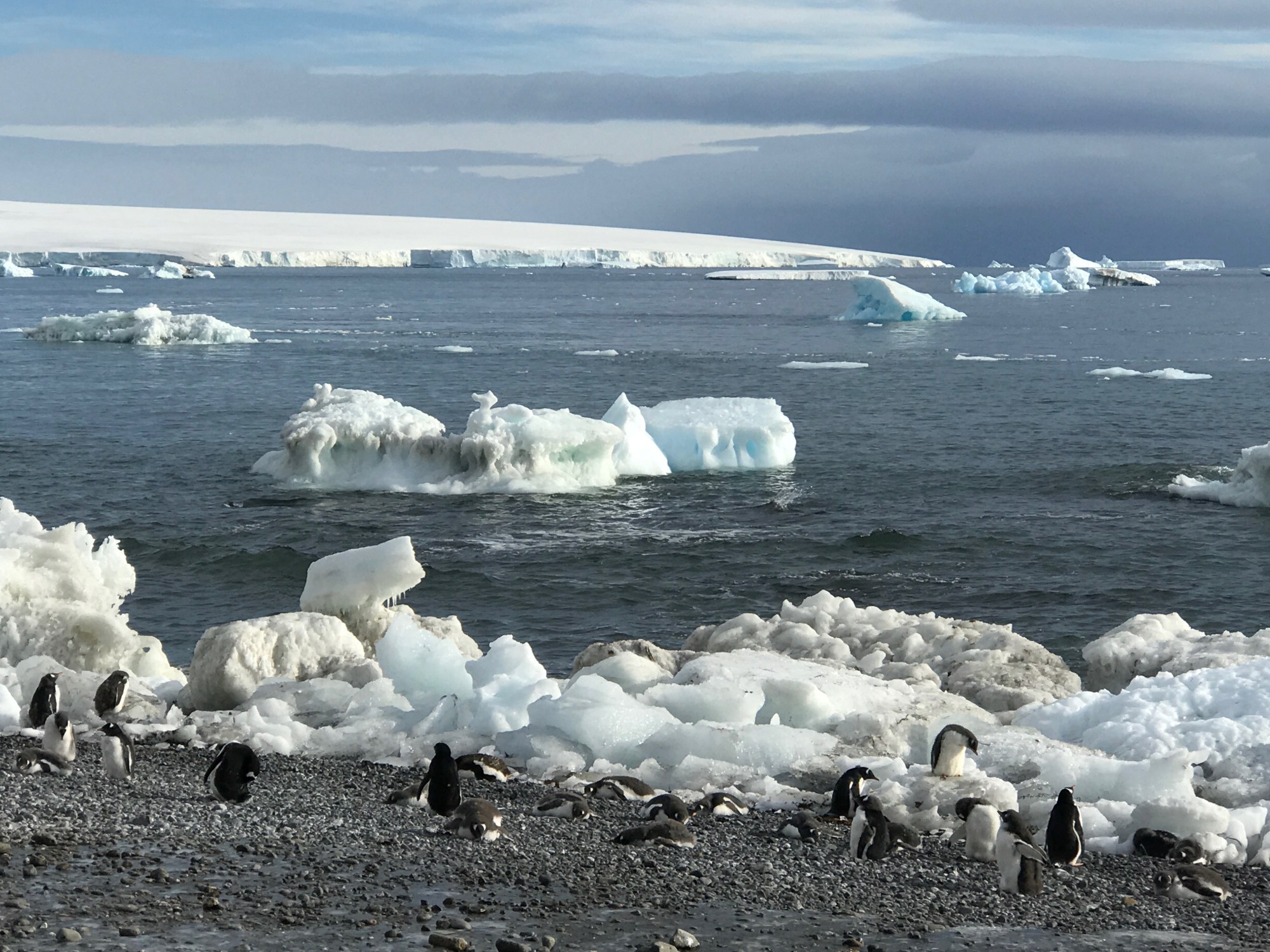
We are traveling along the Antarctic Peninsula this morning and will go ashore on Brown Bluff island. The early-riser photographers went out at sunrise for amazing photo vistas with McDuff, our Nat Geo photographer. Our route this morning passed among icebergs known as Tabular Bergs. They are massive and quite impressive to view.
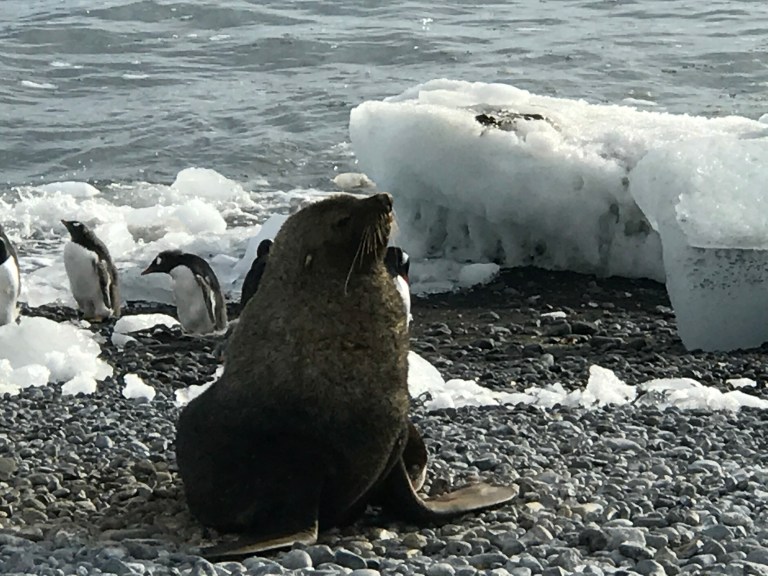
As our Zodiac approached the shoreline of Brown Bluff, we spotted icebergs with several fur seals lounging on them so we made a pass by for photo’s. We disembarked on Brown Bluff and immediately noticed the eerie quiet. In all of the other Penguin rookeries we’ve visited in the last week, the noise level has been high. There are several molting juvenile Adélie penguins and our Naturalist felt that between the stress of our presence and the high temp of 41 (which is making them hot), they are not expending energy “talking.” Very few penguins are in the water feeding and we see several juveniles going down into the shallow waves on the shoreline to get their fluffy molting feathers wet to cool them off.


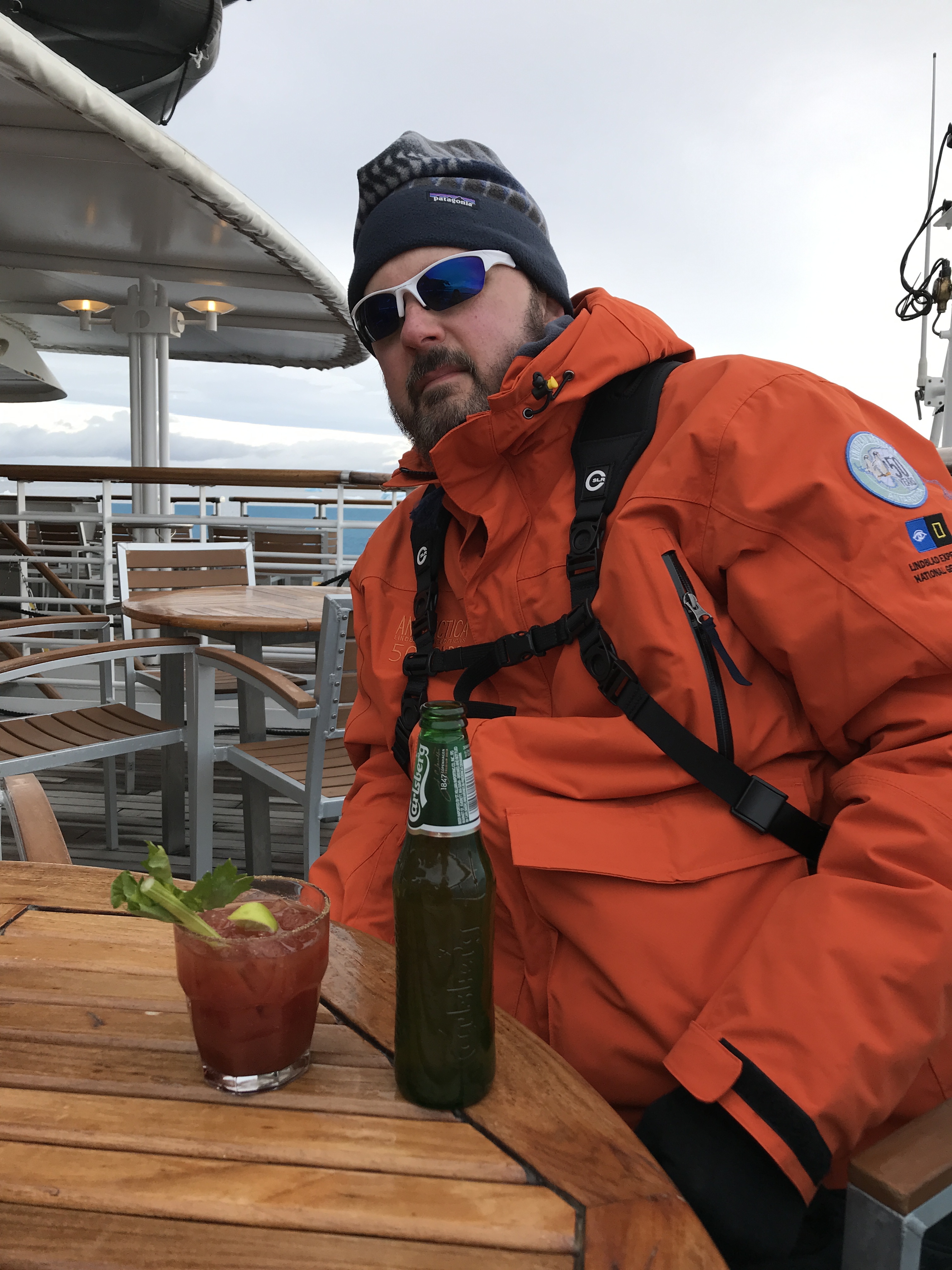
After our shore outing we were welcomed back aboard for a German Frühshoppen with Pretzels, Beer, Bloody Mary’s, Bloody Caesar’s and Brats. Fabulous! We all sat outside on the deck and enjoyed dining in the fresh cool air.


11am The Captain has set course for the northern limits of the Weddell Sea. Upon our departure from Brown Bluff, 2 more slow moving Humpback whales were spotted at the bow of the ship.
11:30am Just Krillin’ lecture by our diver, Caitlyn. Antarctic Krill sustain the entire ecosystem of this area. Krill are tiny little bioluminescent Zooplankton floating throughout the waters of Antarctica that provide food source for the penguins, seals and whales.
After lunch we ventured up to the Bridge to watch our amazing Captain Martin maneuver a complicated path through numerous icebergs, growlers and bergey bits to get us onward to Paulet Island. The path he plotted put the ship alongside a large flat iceberg and we were able to watch a crack grow in size from a narrow line to several feet in width as the section broke away from the berg. It was quite intense on the Bridge, but Captain Martin remained cool and calm and kept eating his bowl of ice cream throughout the maneuver!
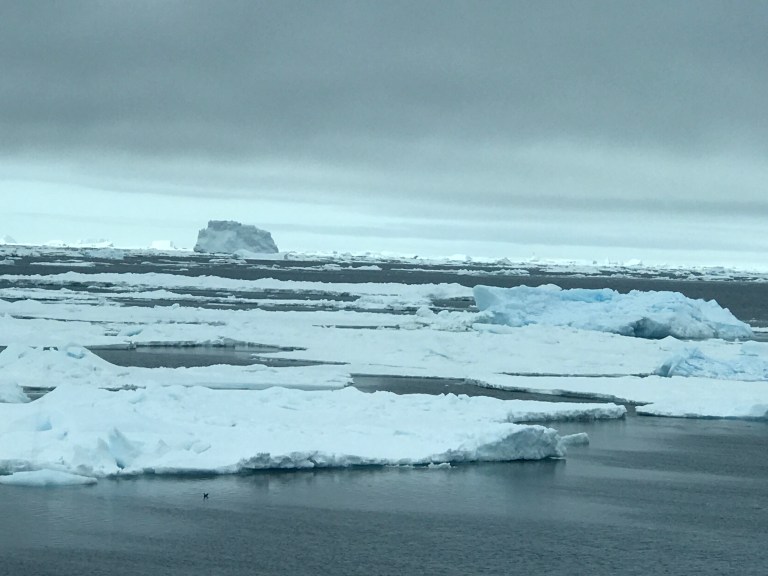


An iceberg with 4 little birds sitting on it just passed by our window about 20 feet away!
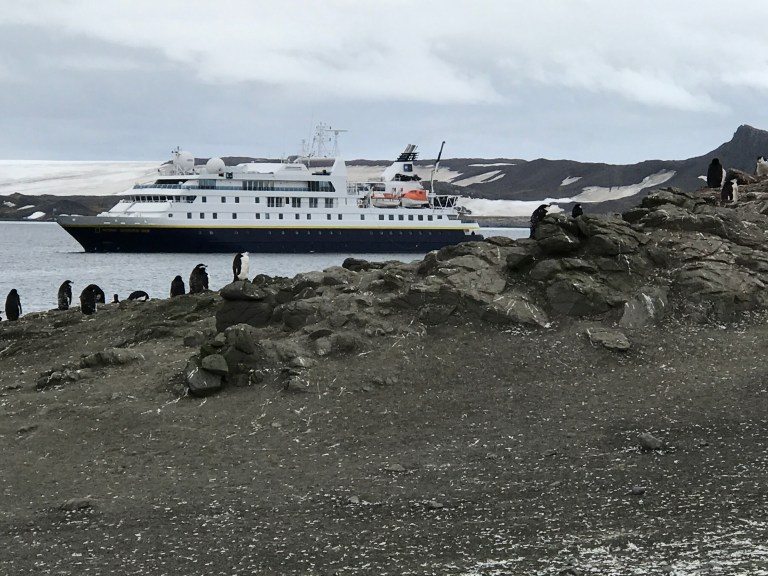
At 3pm our Zodiacs disembarked for Paulet Island. Paulet Island is often inaccessible so we are excited that conditions will permit us to go ashore. On February 12, 1903, the ship, Antarctic, with Captain Larsen at the helm had to alter her course to travel east of the islands. She was trapped in the ice for several weeks and eventually sank 40km east of Paulet. Captain Larsen and members of his party (along with a kitty) sledded for 14 days to reach Paulet where they constructed a stone hut in which they spent the winter of 1903. Today, the ruins (a pile of stones and some roofing timbers) are populated by Adélies. The island beach is very rocky, muddy, slippery and malodorous with a rookery of Adélie penguins. While trying to squat low to photograph a penguin, I slipped and landed in muddy penguin guano. Believe me, this in no way compares to having a bird poop on your head! Needless to say, I stink as bad as the island. Shaun, our expedition leader, hosed & scrubbed me down in my wet suit when I got back to the ship and then sent me to the shower to scrub some more. This is one smell I do not want to remember! Thank heaven my I-phone was spared from getting dunked in the muck.
We have 2 days of sea time ahead of us as we make way to South Georgia island. I’m ready for some R & R. At 5pm the Captain began navigating us through the iceberg field as we departed from Paulet Island. Captain Martin is a master at his craft. We love having free access to the Bridge and watching him work. We really enjoy visiting with him and hearing his stories about his travels through the polar regions.
After our special Blue Ice Antarctic dinner, we had movie night with popcorn and cocktails. The movie showing was the dramatic documentary, “Chasing Ice.”
The Antarctic Peninsula is the northernmost part of the mainland of Antarctica. This mountainous north-eastern arm of the Antarctic continent is a study in contrasts. The western slopes catch heaps of precipitation (usually snow) from the relatively warm, moisture laden air sweeping in via the prevailing westerlies, while the eastern slopes tend to lay in the rain shadow and are much drier with more stable glacier faces that can be very prone to vicious katabatic winds. The western side is also more indicative of the conditions that rule the vast interior of the continent.
Weddell Sea- British sealer James Weddell discovered the sea in 1823 as he sailed aboard his brig the Jane, naming it the George IV Sea. The name was changed to honor Weddell in 1900.
Antarctic Sound is bordered by the Trinity Peninsula to the west and D’Urville, Joinville, Dundee and Paulet Islands on the east. During much of the year, pack ice makes passing through the Antarctic Sound impossible.
 D. Kauten's Travel Blog