Monday, March 5th, 2018 Sunrise: 0603/Sunset: 1916
At Sea en route to the Falklands
“The only thing we have to fear is a giant wheelchair-crushing squid. Well…uh…actually, I guess that’s the only thing I have to fear.” – Franklin D. Roosevelt
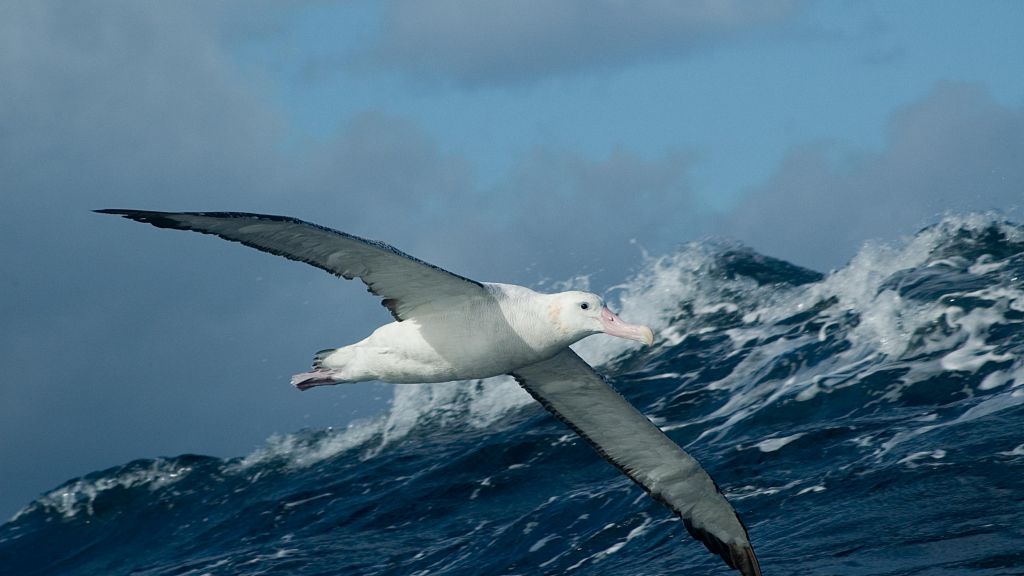
Thankfully, we awoke this morning to calmer seas, low winds and sunshine. We were getting really tired of being tossed about the ship. It’s been a day and a half of huge ocean swells and high winds. Amazingly, we have not had any issues with sea sickness. Apparently, the Captain was rushing to get us to Stanley as there is a major storm moving that direction that he wanted to get ahead of. We slept in late again and had a leisurely breakfast with Leslie and Ray. We had a couple of lectures by the Naturalists during the morning. Then off to lunch with Anitra & Eric & Chuck. I spotted one Albatross flying along beside the ship this morning.

0930 Cetacean Communication – Chris Croxson lecture discussing the fascinating communication abilities of whales.
1100 The Journey of a Whale Barnacle—Conor Ryan discussed the lifecycle of one of the cetacean’s uninvited passengers, the barnacle.
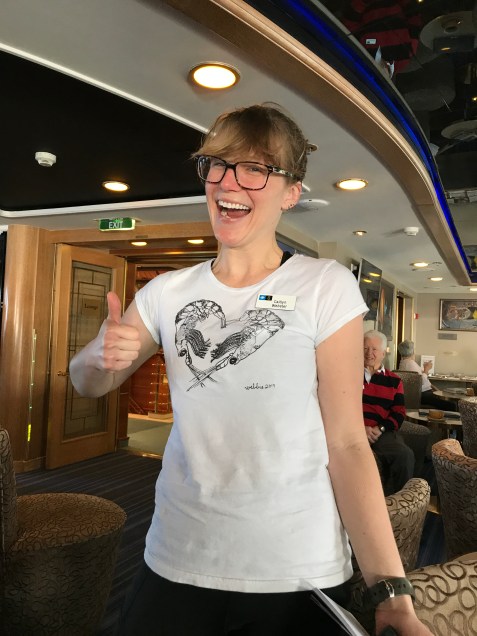
Caitlyn, our diver, has given several presentations on Krill and other little sea critters she’s found on her dives during our trip. She did a hilarious video earlier this week on “Diving Suit Fashions”….very funny. Today she is wandering about the ship in a Krill tee shirt that she designed. I went on line and ordered me one. All monies go to a non-profit ocean fund.
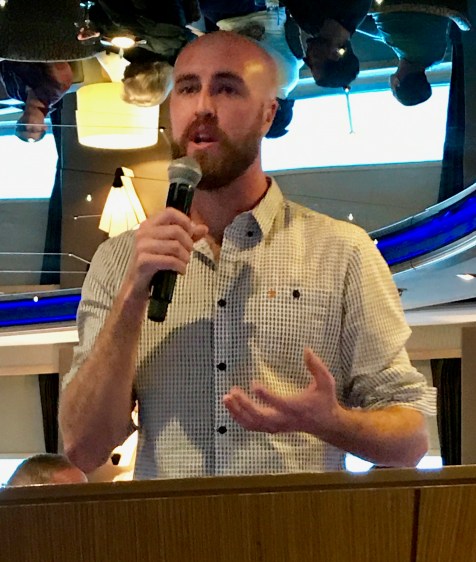
1330 What is Nature: Readings and Photos from Macduff’s Working Manuscript – Macduff Everton discussed excerpts from his work-in-progress manuscript accompanied by some his photographic images.
1500 The Falkland Islands Colonization & Conflict—Peter Wilson lectured on the relatively short but complicated history of humans in the Falklands.
1600 Afternoon Tea & Cocktails in the Lounge.
1800 Evening Cocktail Hour & Recap in the Lounge.
1900 Dinner is served in the Restaurant.
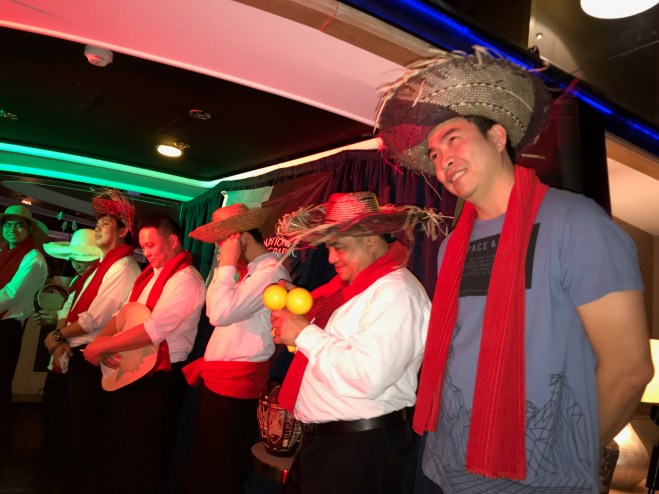
After dinner tonight the ship’s crew put on a show for us. Oh my gosh, it was so much fun and they worked so hard on their performances. They had set up rather sophisticated acoustics and lighting. There was lots of singing and dancing including a group of “Village People” doing YMCA. We were laughing so hard during some of the performances especially Teddy’s group who sang a Speedy Gonzales song. The Captain was off duty tonight and joined us in the lounge for the show. He was having a great time dancing and jumping around….he says that’s about the only exercise he gets on the ship. LOL!


Falklands waters are noted for their high productivity, and for the sustainable management of the fisheries. Squid usually account for around 75% of annual catches of some 200,000 tonnes, most of which are destined for markets in Europe and the Far East. The remainder of the catches consist of various finfish species including Rock Cod, Hake, Hoki and Toothfish. Illex argentinus squid are fished principally by specialist squid jigging vessels from the Far East. Doryteuthis gahi squid are fished mainly by trawlers registered in the Falklands which are owned jointly by Falklands and European companies. There are 20 ocean going fishing vessels registered in Stanley. Squid stocks can be quite volatile due to their one year life cycle, but in a good year the Falklands can supply around 10% of the world squid supply. The fishery has been very successful during this period. The revenue generated by the fishery has been critical to the development of the modern day Falklands. Fisheries revenue has averaged around £20 Million per annum.
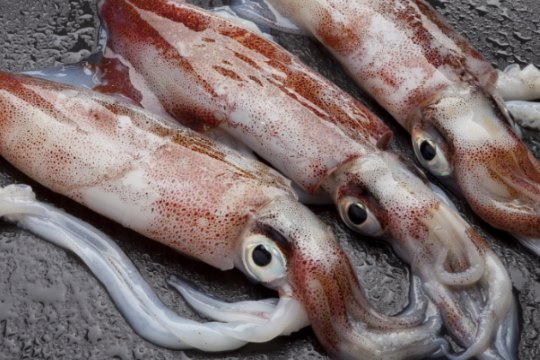
Squid are cephalopods of the two orders Myopsida and Oegopsida. They are 10-armed cephalopods of which there are currently 304 different species. Squids have elongated tubular bodies and short compact heads. Two of the 10 arms have developed into long slender tentacles with expanded ends and four rows of suckers with toothed, horny rings. The body of most squids is strengthened by a feathery-shaped internal shell composed of a horny material. Squid eyes, almost as complex as human eyes, are usually set into the sides of the head. The smallest squid is the Southern pygmy squid (Idiosepius notoides); males grow only to about 1.6 cm (less than 3/4 inch) in length. The largest squids—giant squids and colossal squids—are also the largest living invertebrates. The largest recovered giant squids and colossal squids have measured nearly 13 metres (about 43 feet) long, but there are unconfirmed reports of individuals more than 20 metres (more than 65 feet) in length.
 D. Kauten's Travel Blog