Tuesday, March 6th, 2018 Sunrise: 0626 Sunset: 1935
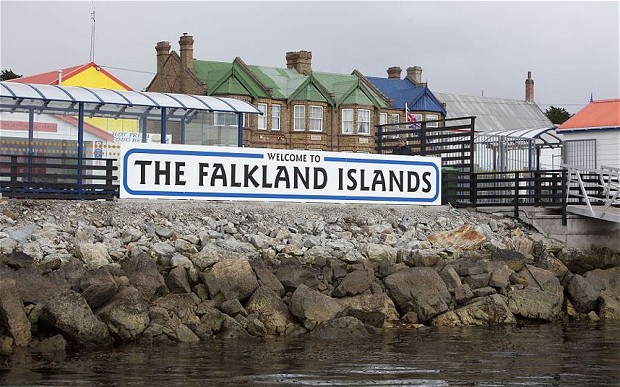
Stanley, Falkland Islands
“We thought there would be a bit of a scrap on the beach, then we would all go have a glass of sherry and I’d tell them to go away and jolly well not come back.” –Governor Rex Hunt on the Argentine invasion
We awoke early this morning with the ship securely docked in Stanley, capital of the Falkland Islands. Stanley was established in the early 1840’s, the site chosen for the sheltered harbour and abundant supplies of peat and fresh water nearby. The town of Stanley is the world’s smallest capital that still manages to have traffic jams because modern SUVs have outgrown the roads. Brightly coloured corrugated iron roofs and painted decorative woodwork are characteristic of older houses in the Falklands. Most of these houses are timber framed, built from kits imported to the islands. Stanley is the hub of the Falklands.
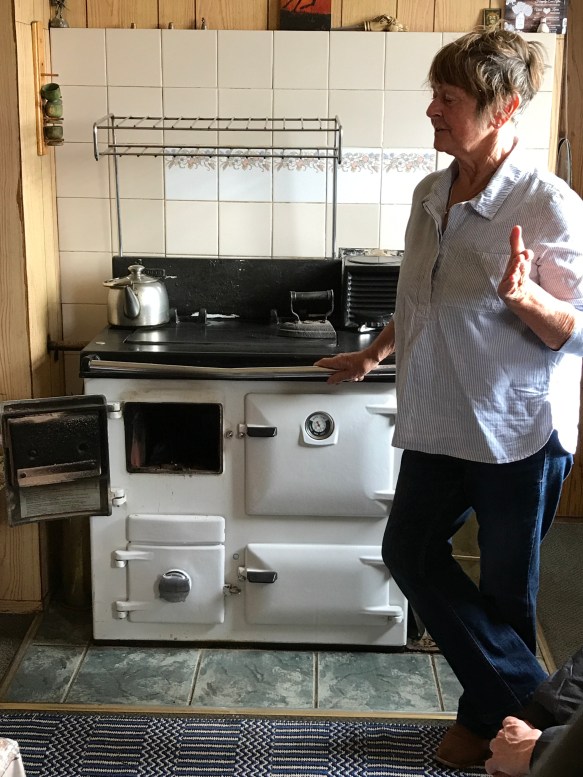
We are thrilled not only to set foot on terra firma, but also that we have gorgeous weather. After breakfast we headed off in buses to visit a traditional farm to watch sheep-shearing and peat-cutting. Long Island Farm is managed by a husband, wife and one son. They have a large sheep herd as well as a few horses and some cattle. They are one of the few farms that still utilize Peat as a source of heat.
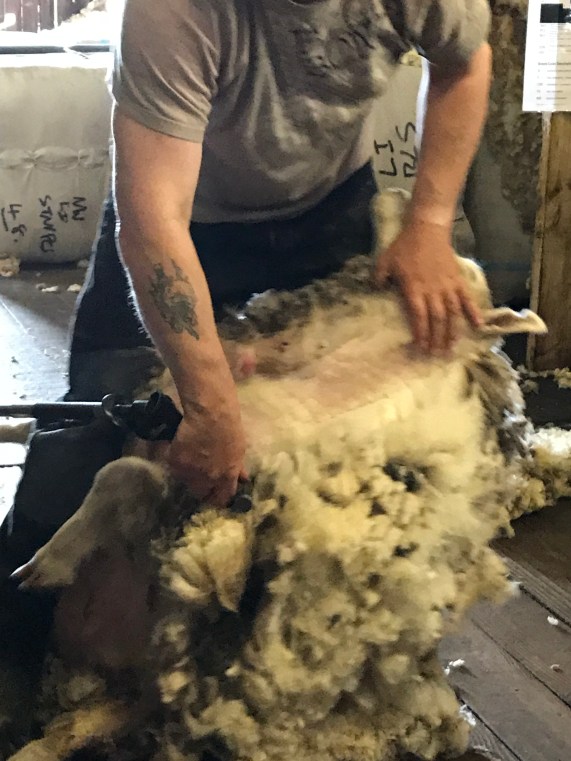
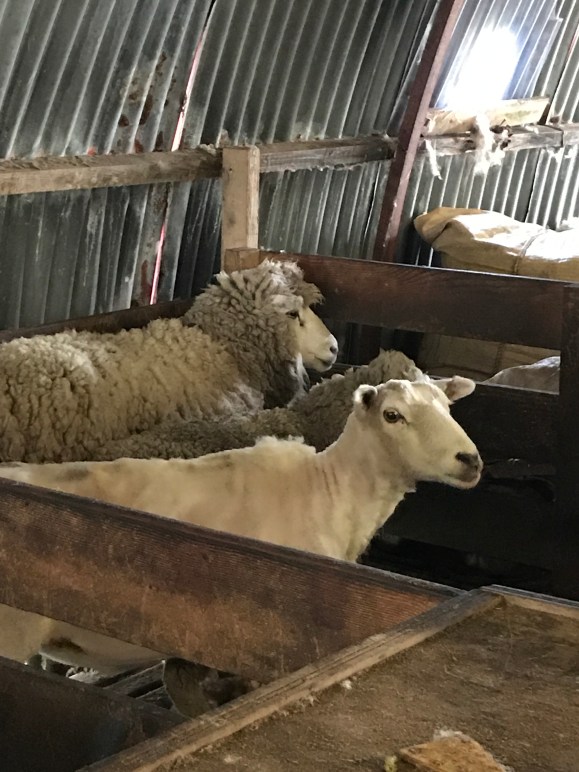

We enjoyed the farm tour until I asked about the pink and purple spray paint marks that were on the sheered sheep. The pink mark means the lamb is too small for butchering for human consumption so she will be slaughtered for dog food. I’ve been depressed about that ever since! I’d never make it as a farmer.
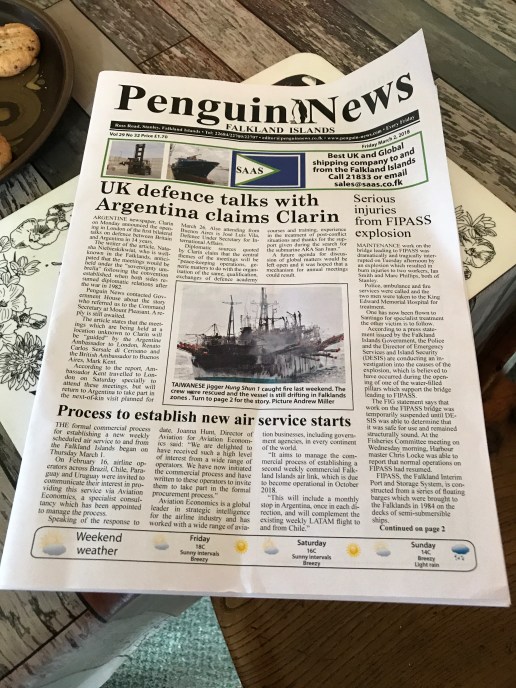
After lunch we took a guided bus tour around Stanley. The information imparted by the local guide about life in the Falklands contributed hugely to the enjoyment of the excursion.

Unfortunately, a 3500 person cruise ship landed at Stanley and has totally inundated the town so we weren’t able to go to any of the little shops because of the crowds.
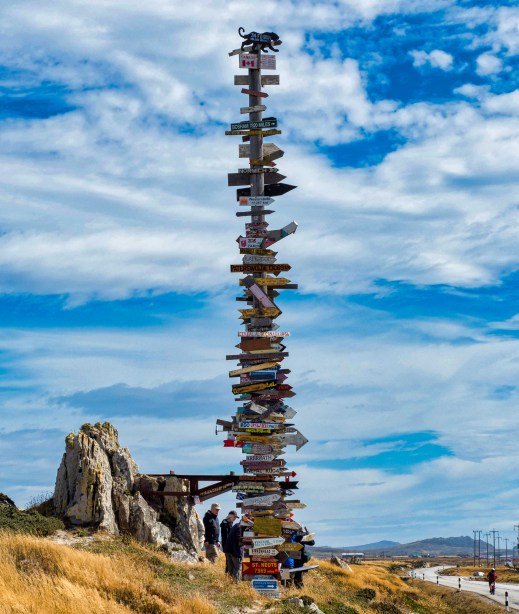
The Falkland Islands derive their name from Falkland Sound, the name given to the waterway between the two main islands by Captain John Strong, who, in his ship Welfare, spent several days in the Islands in 1690. Falkland Sound was itself named after Viscount Falkland, one of the owners of Welfare. The Falkland Islands are an archipelago consisting of two main Islands (East and West Falkland) and 778 smaller islands, with a total land area of approximately 4,700 sq. m. (12,173 sq. km), roughly the size of Connecticut in the USA or just over half the size of Wales in the UK.
The Capital, Stanley, is home to over three quarters of the population. Everything outside of Stanley is known locally as “Camp”, and is home to numerous sheep farms and settlements spread across the archipelago. Several hundred thousand sheep are kept on the islands, producing several thousand tons of wool annually as well as some mutton. The official currency is the Falkland pound, which is on par with the British pound. Standard Chartered Bank, headquartered in London, is the only bank. There is little unemployment in the Falklands, but a shortage of housing has discouraged immigration. The islands’ social welfare system is adequate, and primary education is free. There is a primary and a secondary school at Stanley and several smaller schools in rural areas. College, in England or any other country, is also paid for by the social welfare fund. There are no colleges in the Falklands. Free medical service is provided by a hospital in Stanley.
The Falklands are known as the ‘albatross zone’ and there are nearly always some of these magnificent birds circling the ship effortlessly on outstretched wings, together with numerous smaller seabirds. The currents and upwellings around the coast make for fertile waters and result in concentrations of birds feeding at the surface. Shaun will frequently make announcements from the Bridge when wildlife is spotted so we can run up and take photo’s and watch with our binoculars. As well as wandering and black-browed albatrosses, there were giant petrels (looking like small albatrosses), smaller white-chinned petrels and relatively tiny Wilson’s storm petrels. We are still enjoying watching the “Jesus” birds”, i.e. the Wilson’s storm petrels. They walk on water and it is quite a fascinating thing to watch a tiny bird being able to maneuver over choppy waters on his little feet.
 D. Kauten's Travel Blog