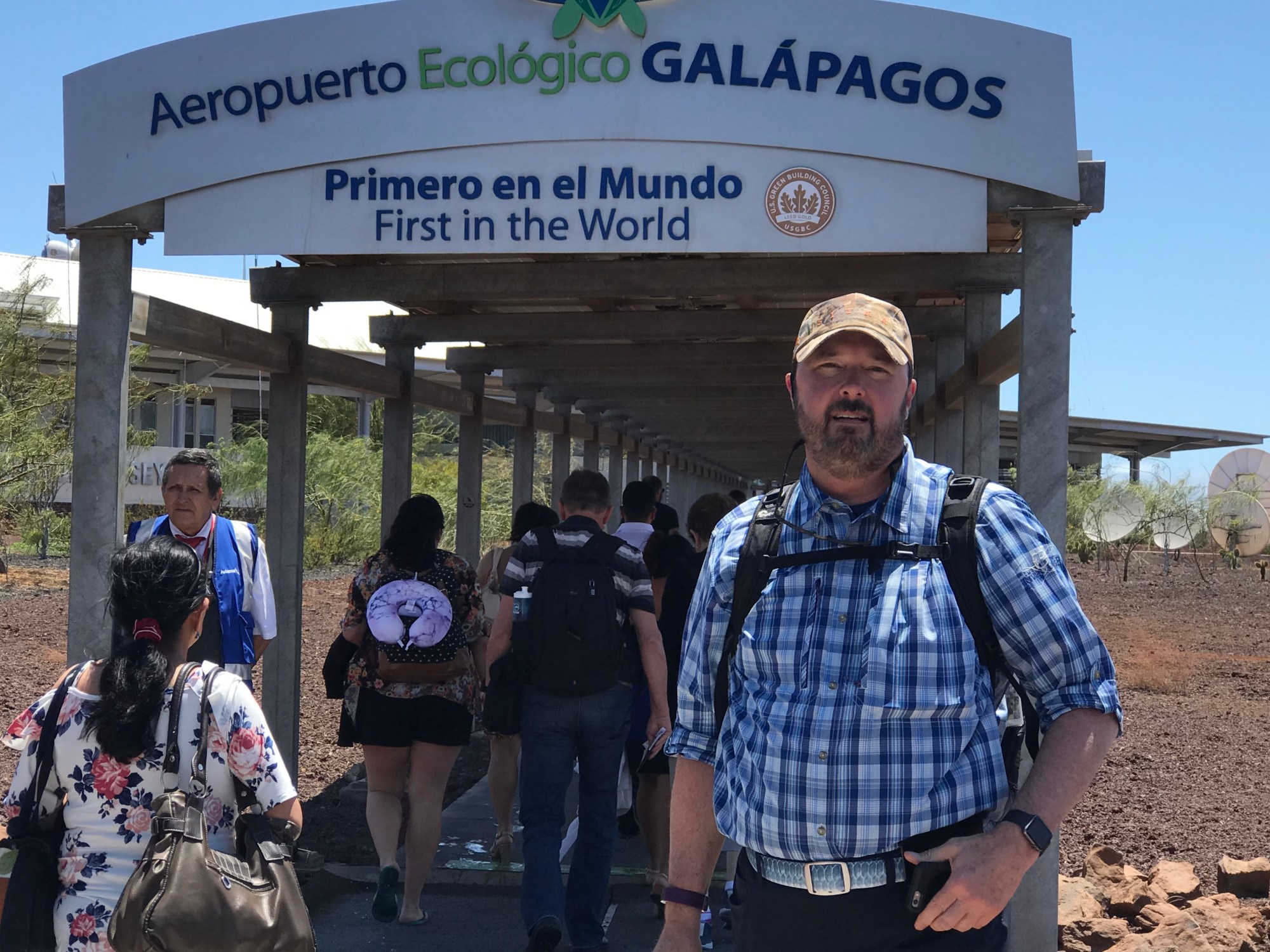
Today we departed on our flight from Quito with a stop in Guayaquil and on to the National Geographic Islander ship on Baltra. Our friends, Cary & Patrice Stowe and their friends, KC & Amy Angert, will join us in Guayaquil.
Guayaquil is Ecuador’s largest city. Chiefly a port and industrial city, Guayaquil is reinventing itself at a dizzying pace.
The Galápagos Islands located about 600 miles off the coast of Ecuador, are one of nature’s most unique outdoor laboratories. The unusual wildlife here helped Charles Darwin formulate his theory of natural selection. Fortunately, not much has changed since Darwin’s time, and the islands still offer the chance to get up close and personal with a wide variety of unique and endemic species, including giant tortoises, marine iguanas, penguins, sea lions, albatrosses, boobies, and flightless cormorants.
Baltra Island, also called South Seymour Island, one of the smaller of the Galápagos Islandsd, with an area of 8 square miles. Before volcanic faulting occurred, the island was a part of Santa Cruz (Indefatigable) Island. During World War II, Ecuador granted the United States permission to establish an air base there (defunct since 1946). With the growth of tourism, the Ecuadoran government renovated the airfield, which is now the main point of entry for visitors to the islands.
After getting settled onto the ship and enjoying lunch, we took the zodiacs to North Seymour island, It is a small island near Baltra Island. It was formed by uplift of a submarine lava formation. The whole island is covered with low, bushy vegetation. The island is named after an English nobleman, Lord Hugh Seymour. North Seymour Island has an area of 0.73 sq mi and a maximum altitude of 92 ft. This island is home to a large population of blue footed boobies and swallow tail gulls. It hosts one of the largest populations of magnificent frigate birds (Fregata magnificens) and a slow growing population of the Galapagos land iguanas.

North Seymour has a visitor trail approximately 1.2 mi in length that we crossed along as we explored the rocky coast.
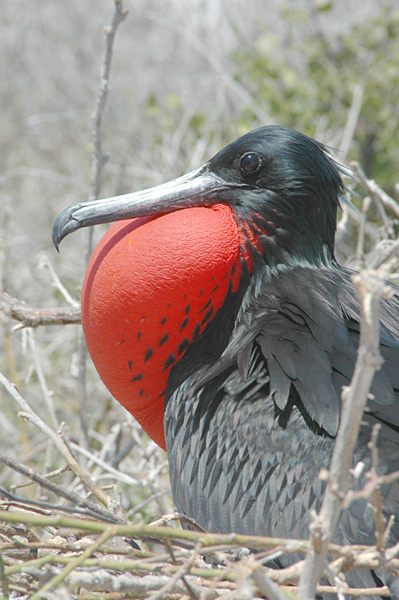
North Seymour was created by seismic uplift, rather than being of volcanic origin. The island has a flat profile with cliffs only a few meters from the shoreline, where swallowtail gulls and tropic birds sit perched in ledges. A tiny forest of silver-grey Palo Salto trees stand just above the landing, usually without leaves, waiting for rain to bring them into bloom. While visiting the island, we observed sea lions, blue-footed boobies, pelicans and swallow-tailed gulls feeding off shore.

National Geographic Islander: Upper Deck

 D. Kauten's Travel Blog