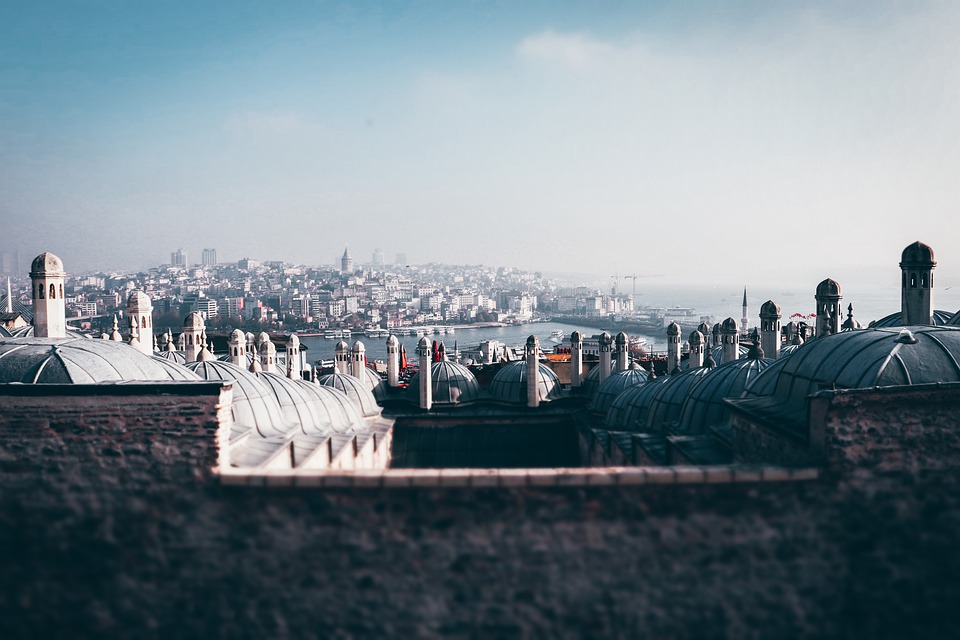
Merhaba, which means Hello in Turkish. We’re up and ready to officially meet Istanbul. After a fairly peaceful night of rest, we headed down to the waterside café for breakfast. It always fun to try some local foods. I enjoyed some Kol Böregi (Turkish pastry filled with potatoes and cheese) and Peynirli Gözleme (a meat filled pastry roll) as well as a Turkish Simit (Turkish bagel) with honeycomb.
9:00am We met the nurse in a private hotel room for our mandatory Covid Testing to get on the cruisee ship tomorrow. Not a terribly unpleasant experience except that their testing involves swabbing the throat and both nostrils. We will sit on pins and needles until 6pm tonight when we get our results.
9:30am Off we go to tour Istanbul with Gamza, our guide and Guvem, our driver in a very comfortable touring van. As it is Saturday, traffic and tourist crowds will be very heavy today.
As we exit our hotel we notice that the pedestrians on the streets and very young. Apparently our hotel is surrounded by universities and student housing. There are over 50 Universities in the city.
Istanbul has a long and complex history. Formerly known as Constantinople, it is the largest city and principal seaport of Turkey. Istanbul is the economic, financial, and cultural center of Turkey. It’s also the country’s biggest city with a population of just over 15 million people. The city is located on both sides of the Bosphorus which makes Istanbul geographically interesting in that it’s one of a handful of cities that straddles two continents. The western half of the city is situated in Europe while the eastern half is located in Asia. The Asian side is largely residential so you’ll find most of the city’s major attractions clustered within two districts on the European side – Sultanahmet and Beyoğlu. This is where we will be spending our day.
Although not Turkey’s capital, Istanbul has been regarded as one of the world’s greatest cities for centuries. Still dotted with remnants of Roman and Greek empires and a Christian heritage, it uniquely straddles the divide between Europe and Asia and is also heavily influenced by the dominant Islam religion and its Middle Eastern links. Interesting note….Three percent of Turkey is in Europe and 97% is in Asia. Istanbul straddles both continents, connected by a bridge over the Bosphorus. The city is the world’s only metropolis to be on more than one continent.
We drive across a bridge over the Golden Horn, a natural harbor.
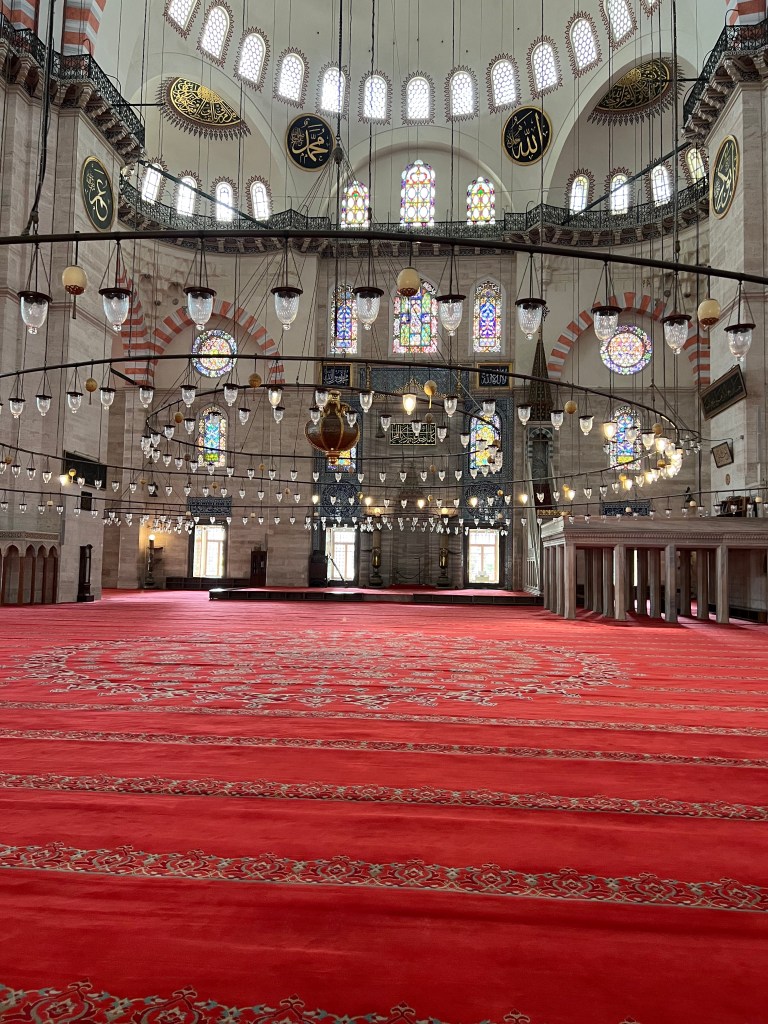
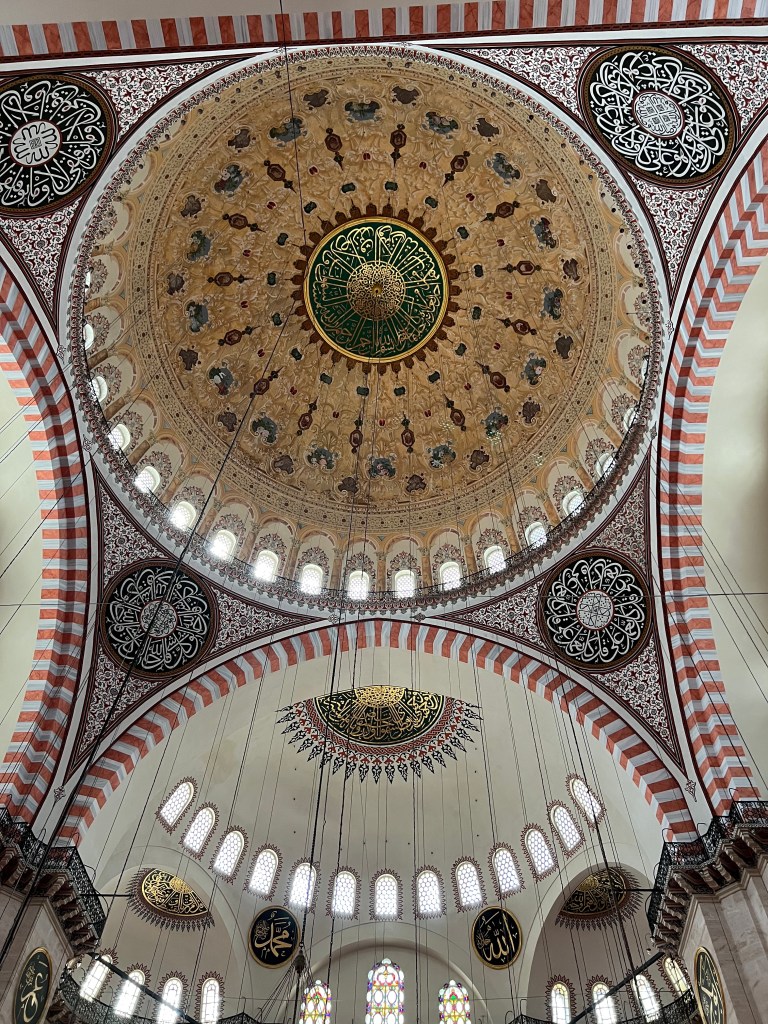
Our first stop is the Süleymaniye Mosque, an Ottoman imperial mosque located on the Third Hill of the city. We are fortunate to arrive before the tourist crowds have descended. This magnificent structure stands erect in all her glory since 1557 in spite of two fires. The beautiful stained glass windows have remained intact all these years. It is a fitting tribute to Suleyman who was the longest-reigning sultan of the Ottoman Empire (1520-1566). After the fire in 1660 it was restored by architect, Fossati (under the command of Sultan Mehmet IV) and was changed into a more baroque style, damaging the original design. During World War I, the courtyard was used as a weapons depot, which led to another fire when some of the munitions ignited. It wasn’t fully restored again until 1956.
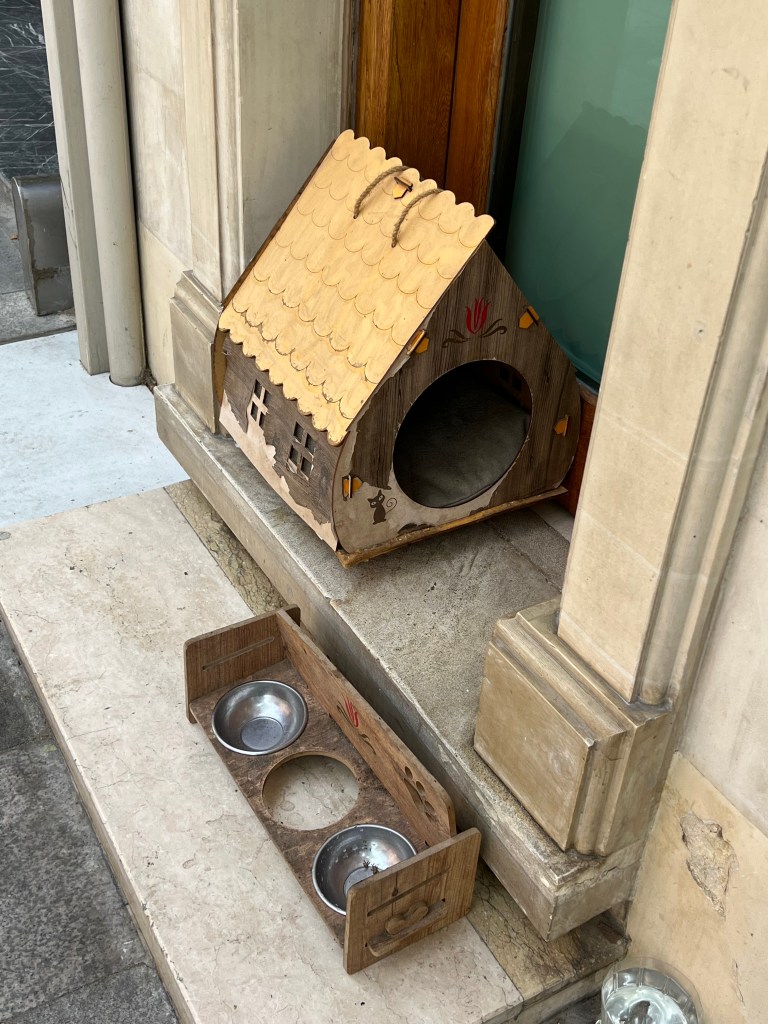
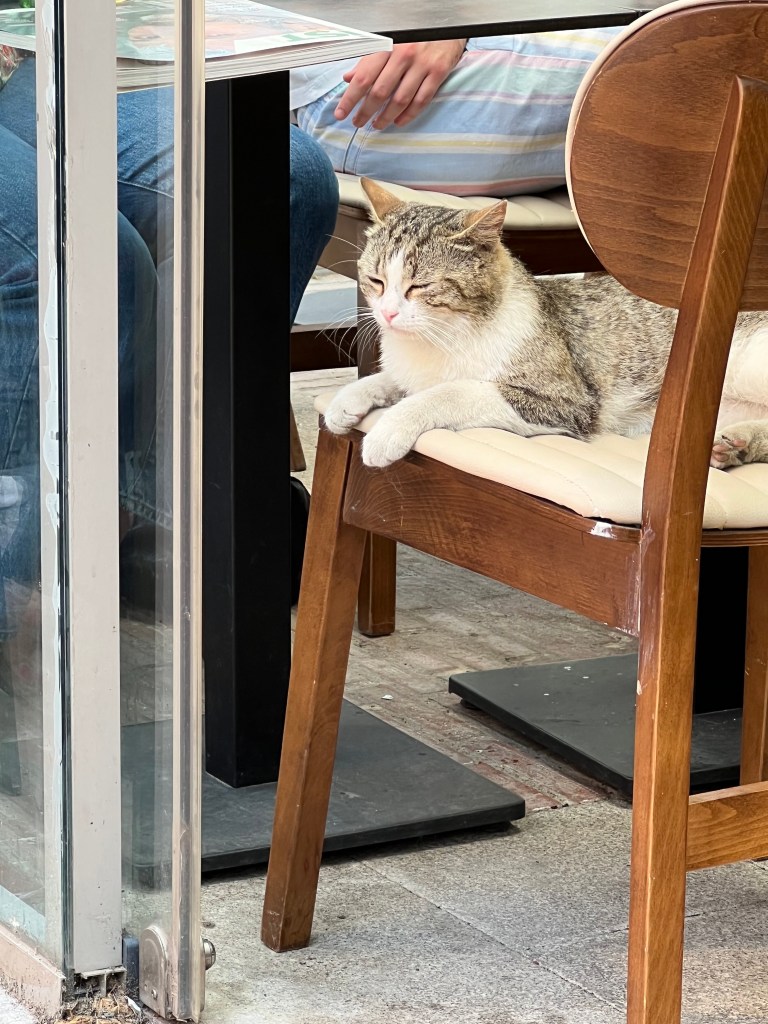
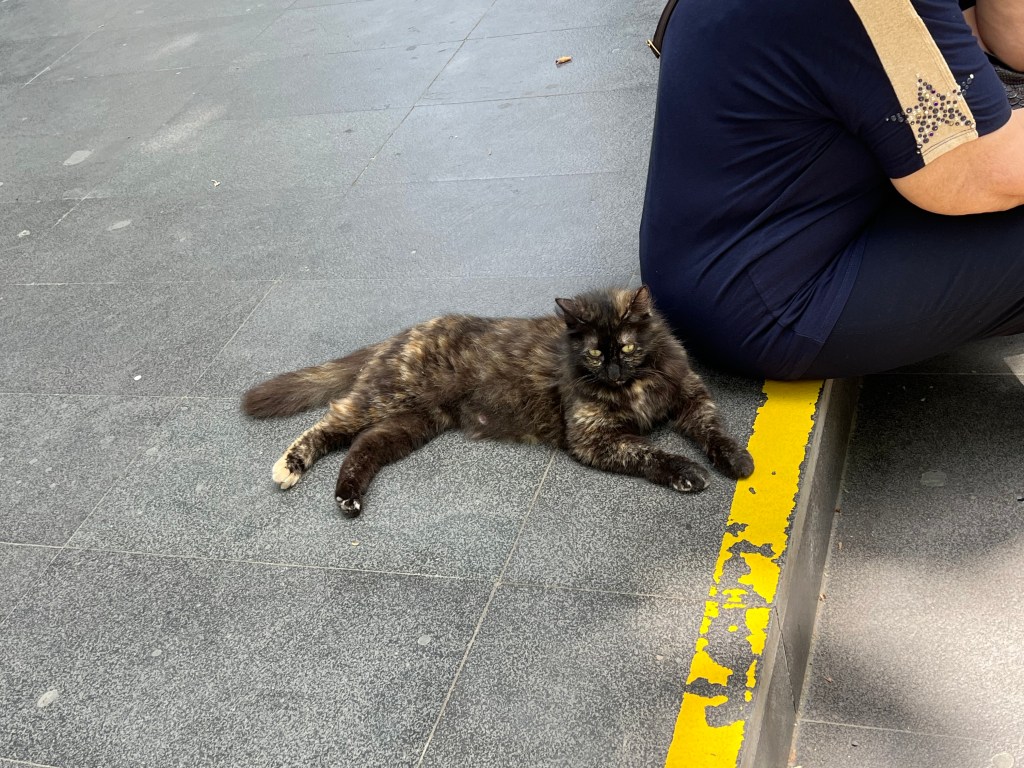
Cats (Kedi) rule the city! Needless to say we are thrilled with this news. Nothing we love more than seeing cats everywhere! It took only a few minutes upon exiting our van to notice cats all about. Kitties are revered in Istanbul, and very well taken care of. Shop owners and restaurants will leave out bowls of cat food, water and even milk outside. There are also little cat houses for winter weather when it’s too cold to be on the street. Many cats actually get fixed or vaccinated or both, and you will know this because there will be a little piece missing from one of their ears.
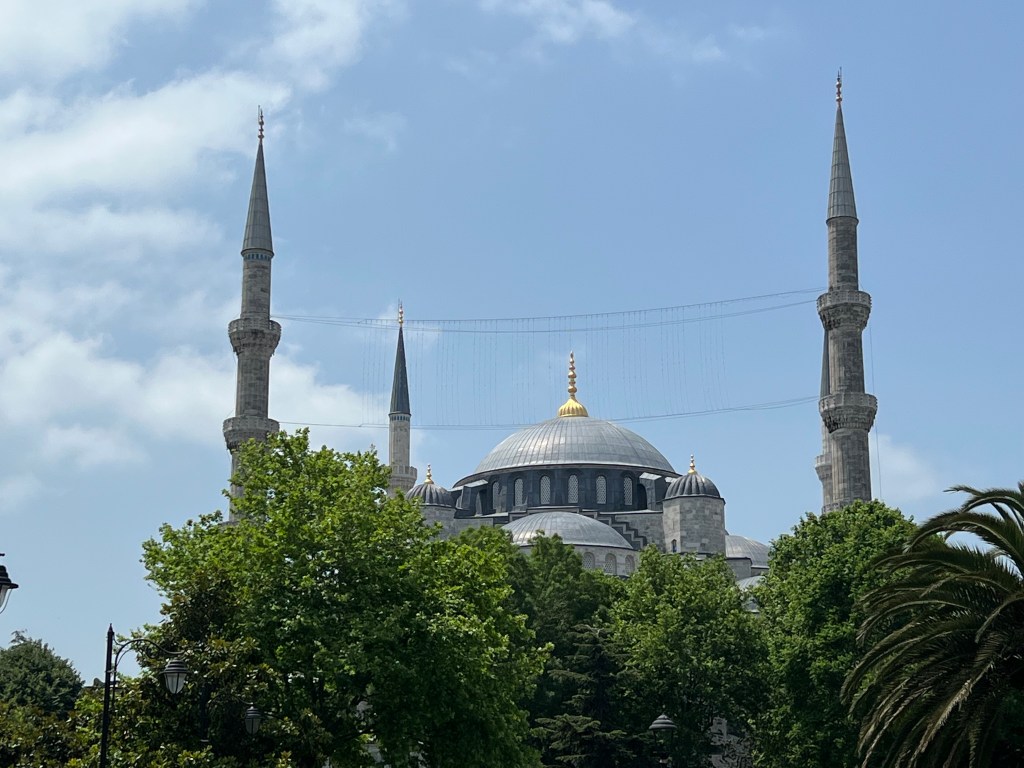
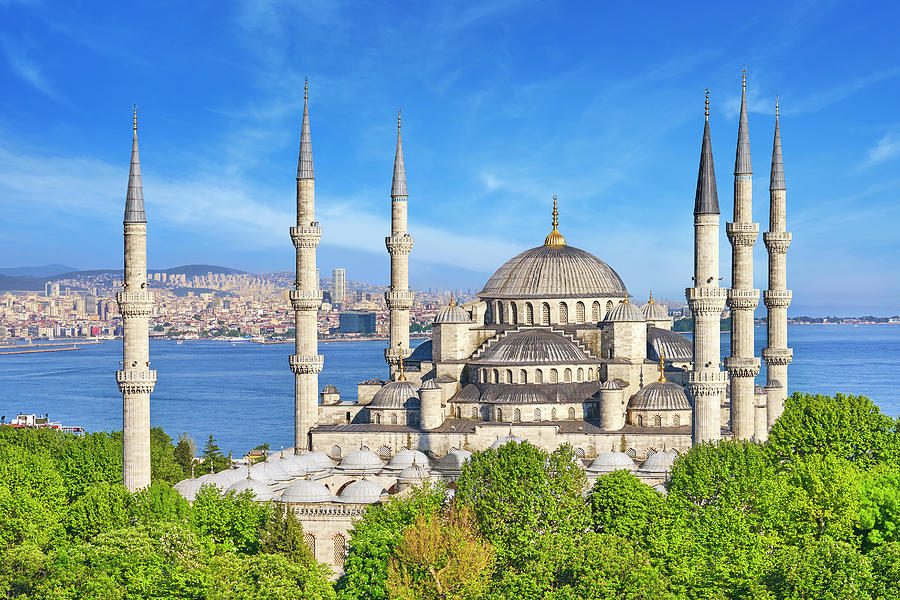
Our next stop was the Blue Mosque. The Blue Mosque (Sultanahmet Camii) was built between 1609 and 1616 during the rule of Ahmed I, and is so named because of blue tiles surrounding the walls of interior design. Besides being a tourist attraction, it’s also an active mosque, so it’s closed to non worshippers during the five daily prayers. Light inside the mosque is provided by the more than 200 stained glass windows and several chandeliers. They put ostrich eggs on the chandeliers to repel spiders, hence avoiding cobwebs inside the mosque. The floors are covered with carpets, which are donated by faithful people and are regularly replaced as they get worn out.
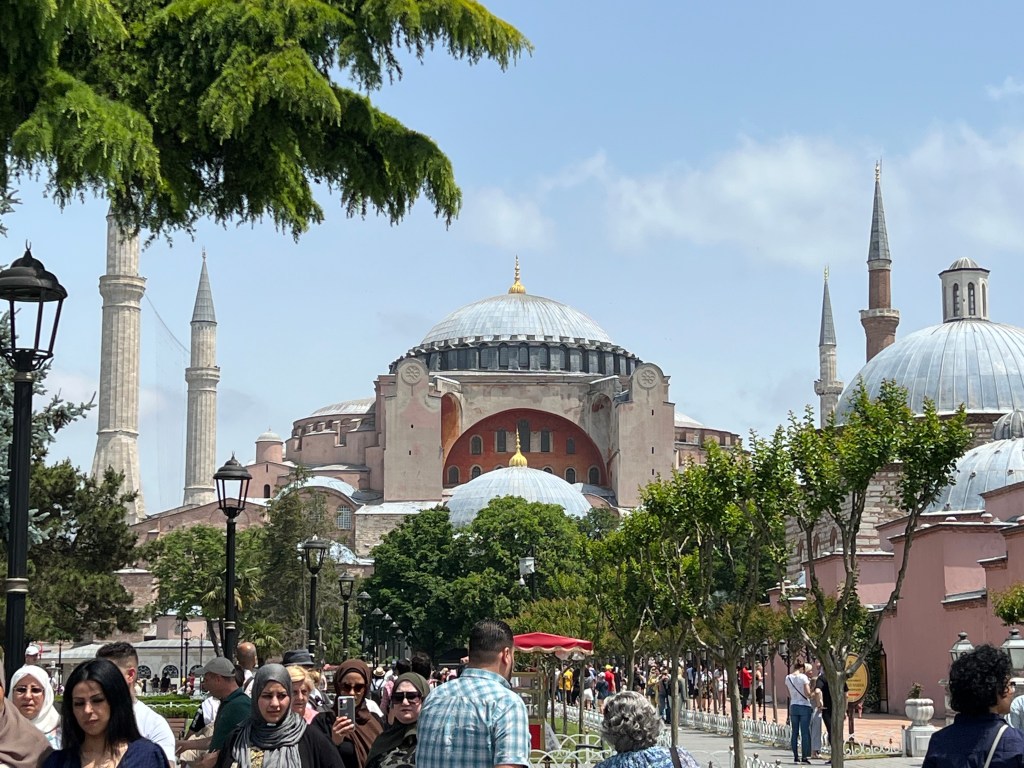
The Hagia Sophia is located nearby so we walked over to visit it next. By now the tourist crowds have swollen and it is very crowded in the mosque. It is obvious that everyone has tired of Covid lockdown and are now moving on with life as usual with no social distancing and very few masks noted on anyone.
Hagia Sophia, also called Church of the Holy Wisdom or Church of the Divine Wisdom, is an important Byzantine structure and one of the world’s great monuments. It was built as a Christian church in the 6th century CE (532–537) under the direction of the Byzantine emperor Justinian I. In subsequent centuries it became a mosque, a museum and a mosque again. The building reflects the religious changes that have played out in the region over the centuries, with the minarets and inscriptions of Islam as well as the lavish mosaics of Christianity. It is interesting to note that the Christian mosaics are covered over by draping now that the structure serves as a mosque again. The opening ceremony for worship in Hagia Sophia Mosque was held on 24 July 2020, with the attendance of President of the Republic of Turkey, Mr. Recep Tayyip Erdoğan.
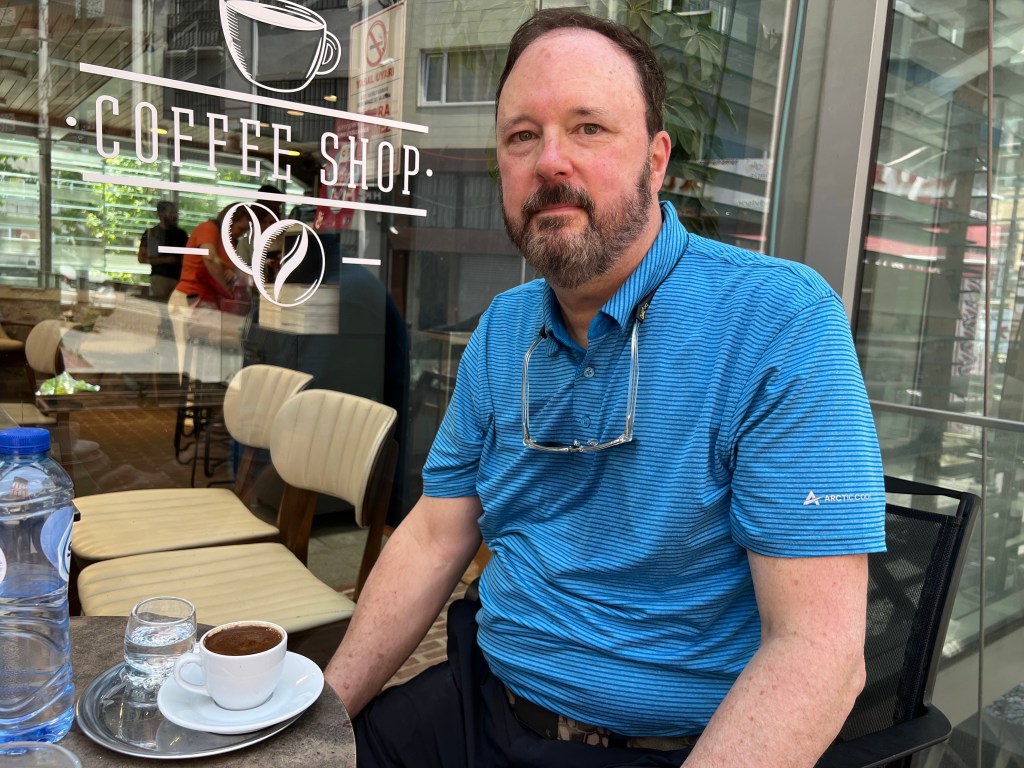
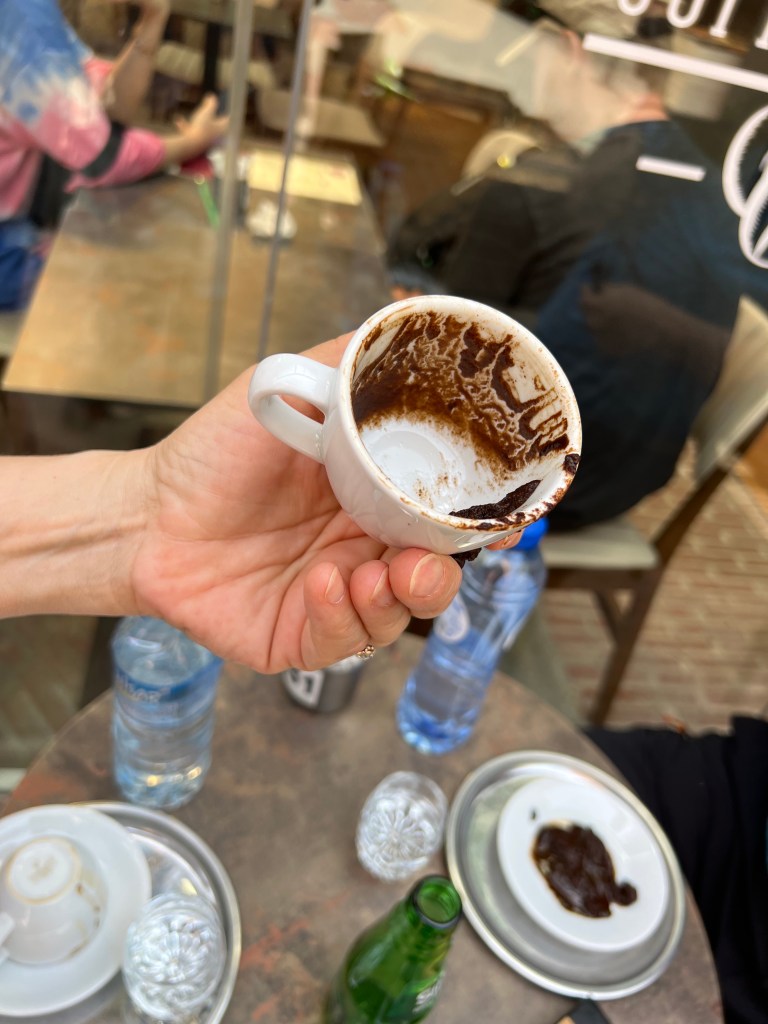
We stopped for a quick stop for the famous Turkish coffee. Apparently, there are those who can “read” the meaning of the sludge left at the bottom of the cup such as people who “read” tea leaves. I see nothing but coffee gunk!
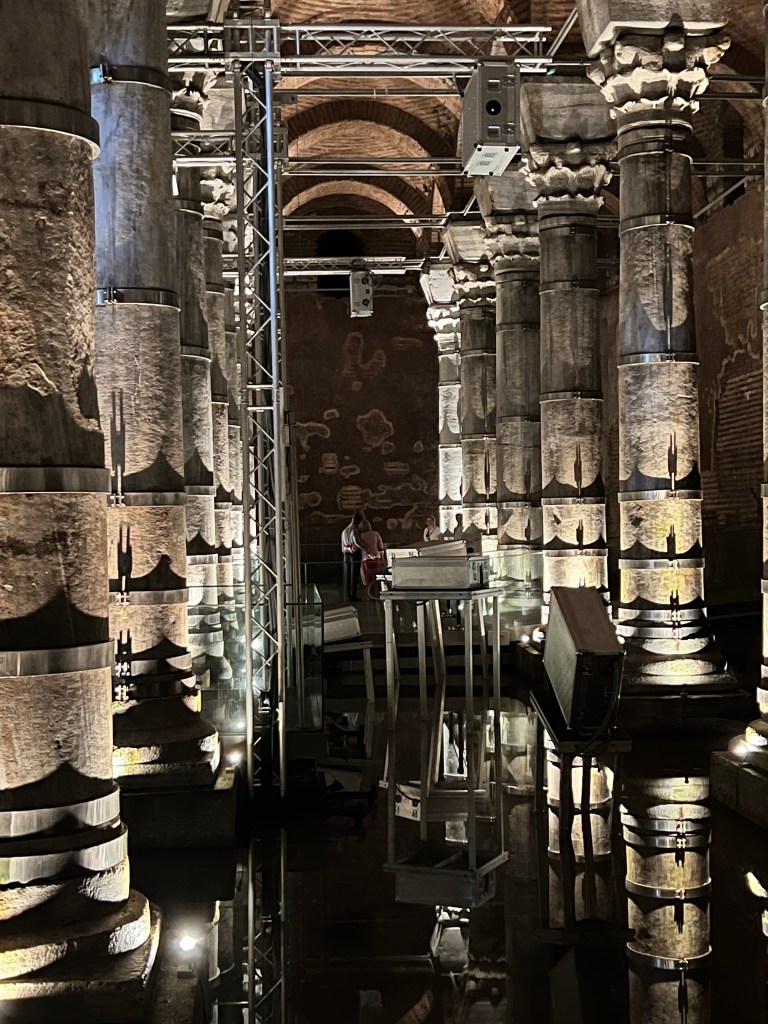
Below the coffee shop lies the Şerefiye Cistern, one of the oldest water structures in the Historic Peninsula of Istanbul with a history dating back almost to 1,600 years ago and was built during the reign of Theodosius II (408 – 450). We climbed down a steep set of concrete stairs into the cistern where the temperature was delightfully cool. Due to the inadequacy of water resources in Istanbul, there was a need for structures to store water due to the population density and the sieges. While open and closed cisterns served as the water tanks of the city for centuries, it is known that the magnificent closed cisterns (such as the Şerefiye and the Basilica Cisterns) mainly supplied water to the Great Palace, Nymphaeum and Zeuksippos Baths. [Sadly, the main Basilica Cistern is closed for refurbishment so we are unable to visit it.]
Built on an area of 24 to 40 meters on the edges and reaching as high as 11 meters, there are 45 sail-vaults and 32 columns inside the Şerefiye Cistern. All of the Corinthian decorations with impost blocks were made of Marmara Island marble and specific to the Cistern. The column tops are decorated with acanthus (bear’s-paw) leaves. The interior walls of the monument are covered with waterproof plaster while the corners are curved to withstand water pressure. The walls are about 2.5 meters thick.
The Şerefiye Cistern is the first museum of Turkey with 360° Projection Mapping system and the oldest building in the world to which this system has been integrated. We arrived just in time to experience the new projection show. The show consists of five main parts with the spatial features of the Şerefiye Cistern and 3D effects reflected on the walls, columns and ceiling.
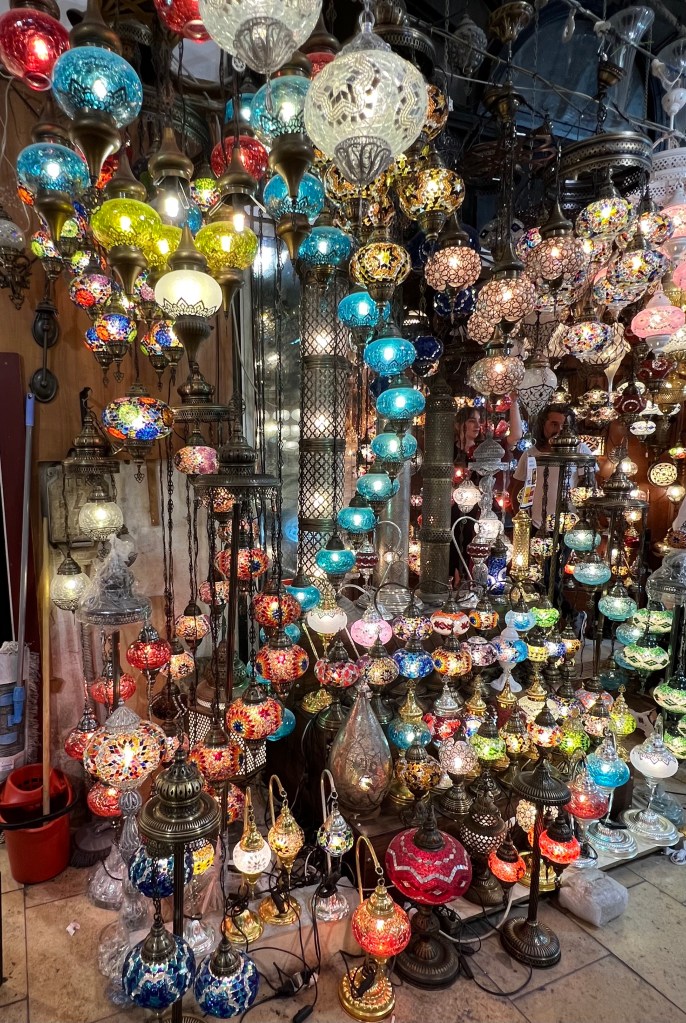
Next we walked to the Grand Bazaar. Istanbul’s Grand Bazaar spans 30,700 square meters and is the largest covered market in the entire world. Once inside, the 64 streets and smaller lanes are home to around 4,000 shops, as well as the bazaar’s own mosque, post office, restaurants, banks, and police station, making it a central city in miniature. You can easily get lost in this mecca of shopping! The bazaar began its life in 1461 and steadily expanded, swallowing up surrounding ground over the centuries of Ottoman rule.
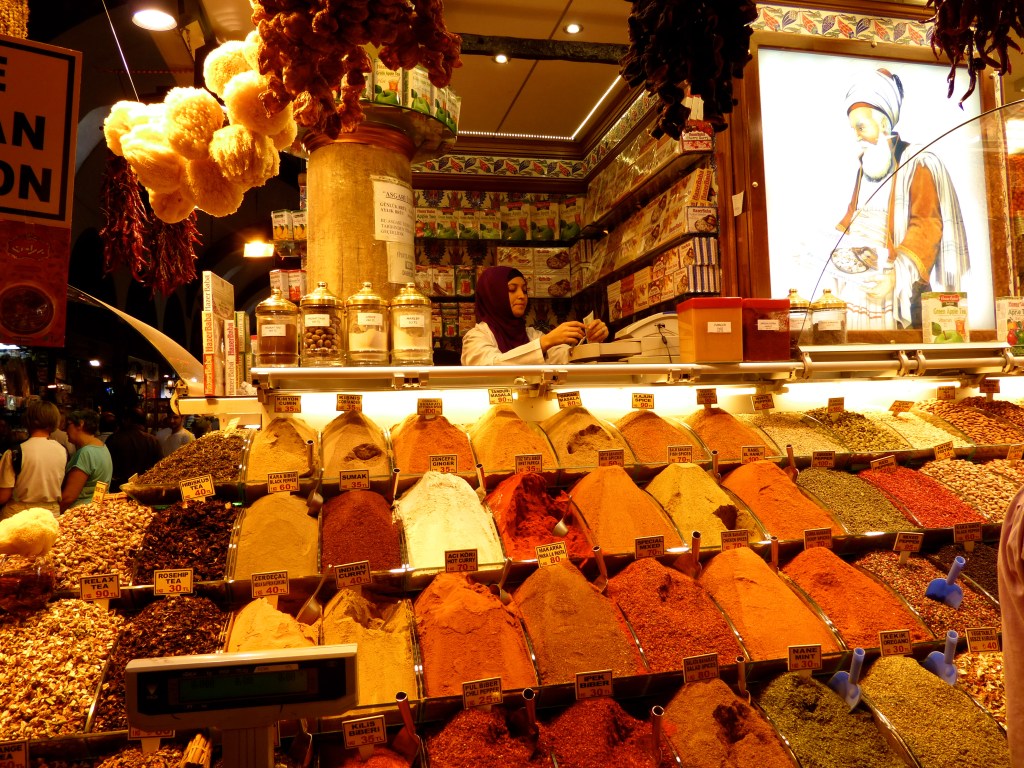
We walked a short distance over to the Spice Market. It was a challenge walking through there as it’s very crowded today. We stopped in one shop and picked up some spices and nuts and then headed back to the hotel. We’re pooped out.
Took a little time to rest and reboot before heading down to dinner at Aqua on the waterfront. The menu is seafood centric and delicious. The young chef came out to get our opinion of his new menu. Yummy!
Notes on Turkey:
Turkey was home to two of the seven wonders of the ancient world. One was the temple of Artemis in Selcuk, and the other was the Mausoleum of Halicarnassus in Bodrum.
The old walled city stands on a triangular peninsula between Europe and Asia. The old city contains about 9 square miles, but the present municipal boundaries stretch a great deal beyond. The original peninsular city has seven hills, requisite for Constantine’s “New Rome.” Six are crests of a long ridge above the Golden Horn; the other is a solitary eminence in the southwest corner. Around their slopes are ranged many of the mosques and other historic landmarks that were collectively designated a UNESCO World Heritage site in 1985.
The waters washing the peninsula are called “the three seas”: the Golden Horn, the Bosporous, and the Sea of Marmara. The Golden Horn is a deep valley about 4.5 miles long. Early inhabitants saw it as being shaped like a deer horn. The Bosporus is the channel connecting the Black Sea to the Mediterranean by way of the Sea of Marmara and the straits of the Dardanelles.
Like the forces of history, the forces of nature impinge upon Istanbul. The great rivers of Russia and middle Europe—the Danube, Don, Dnieper and Dniester—make the Black Sea colder and less briny than the Mediterranean. The Black Sea waters thrust southward through the Bosporus, but beneath them the salty warm waters of the Mediterranean push northward as a powerful undercurrent running through the same channel.
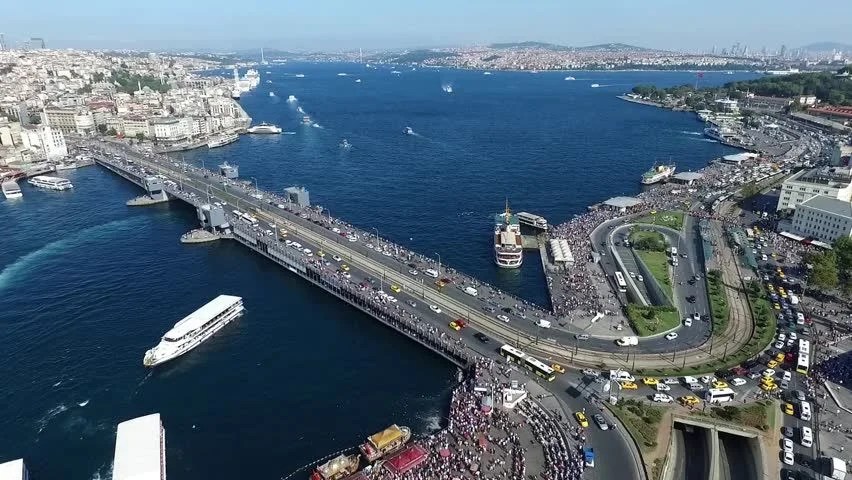
The Galata and Atatürk bridges cross the Golden Horn to Beyoğlu. Each day before dawn their centre spans are swung open to allow passage to seagoing ships. The shores of the Horn, served by water buses, are a jumble of docks, warehouses, factories, and occasional historical ruins. Ferries to the Asian side of Istanbul leave from under the Galata Bridge. Istanbul has three of the world’s longest suspension bridges: Bosporus I (Boğazici) Bridge (completed in 1973), with a main span of 3,524 feet; Bosporus II, the Fatih Sultan Mehmed Bridge (1988), 3,576 feet; and Bosporus III, the Yavuz Sultan Selim Bridge (2016), 4,620 feet. Two tunnels under the Bosporus, one for passenger rail and one for automobile traffic, were opened in 2013 and 2016 respectively.
The largest legacy from the capital of the vanished empire is 25 Byzantine churches. Many of these are still in use—as mosques. The largest of the churches which is considered one of the great buildings of the world is the Hagia Sophia, whose name means “Divine Wisdom.” Its contemporary and neighbour, St. Irene, was dedicated to “Divine Peace.”
In the period following World War II, the size and population of Istanbul increased dramatically as vast numbers of rural residents moved to the city in search of employment. This nearly 10-fold increase in the city’s population during the second half of the 20th century placed enormous strains on Istanbul’s infrastructure, and, in a pattern typical of large Middle Eastern cities, overcrowding, pollution, and insufficient city services became major social problems.
Istanbul, like other major cities, attracts an increasing number of migrants. These migrants have contributed to the growth of shantytowns called gecekondu (literally “set down by night”) that have no sanitation facilities and limited access to power and water. The Christian and Jewish minorities continue to shrink both in percentage of the whole and in overall numbers. Kurds now constitute the largest ethnic minority in the city.
Istanbul is Turkey’s largest port and the hub of its industry. Textiles, food processing, flour milling, tobacco processing, cement, and glass are the city’s principal manufactures. Tourism and finance sectors are growing sources of income for Istanbul as well.
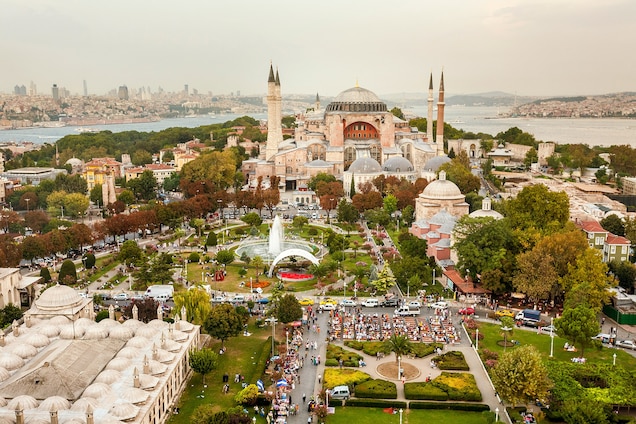
In 1985 the Hagia Sophia was designated a component of a UNESCO World Heritage site called the Historic Areas of Istanbul, which includes that city’s other major historic buildings and locations.
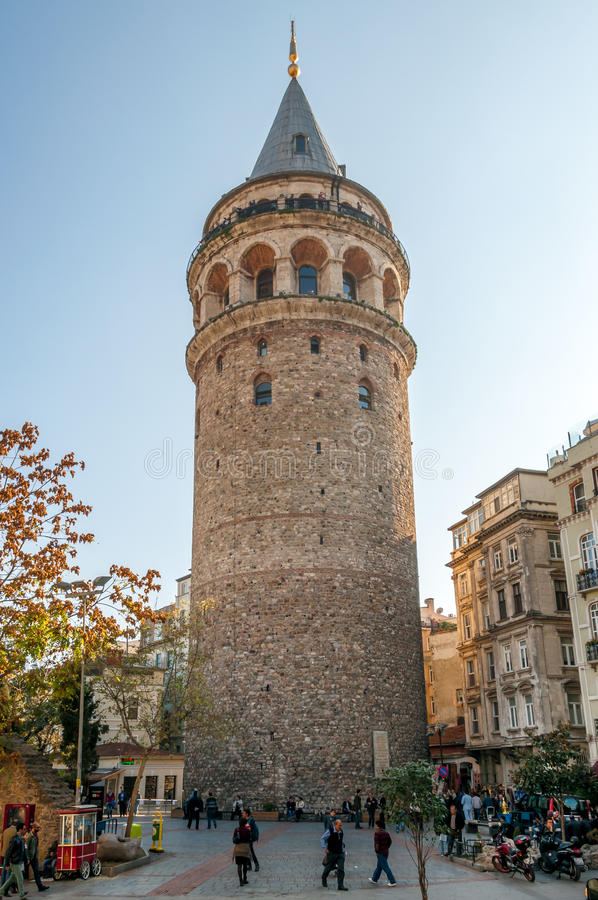
The Galata district is dominated by a massive tower that shares its name. The tower was built by the Genoese traders in 1349 as a watchtower and a fortification for their walled enclave.
The 673-year-old Genoese Galata Tower—one of Istanbul’s most popular sites—got a lengthy refresh over the last two years, recently reopening as a museum.
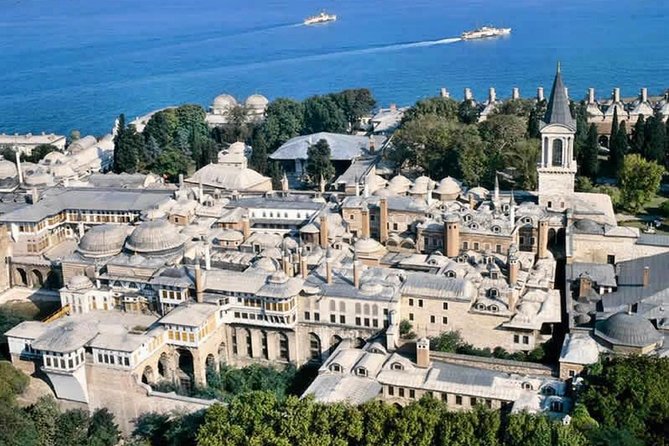
Unfortunately, we were unable to visit the Topkapi Palace as it is closed for renovation. Topkapı Palace and Harem (Topkapı Sarayı) are likely to have more colourful stories than most of the world’s museums put together. Libidinous sultans, ambitious courtiers, beautiful concubines and scheming eunuchs lived and worked here between the 15th and 19th centuries when it was the court of the Ottoman empire.
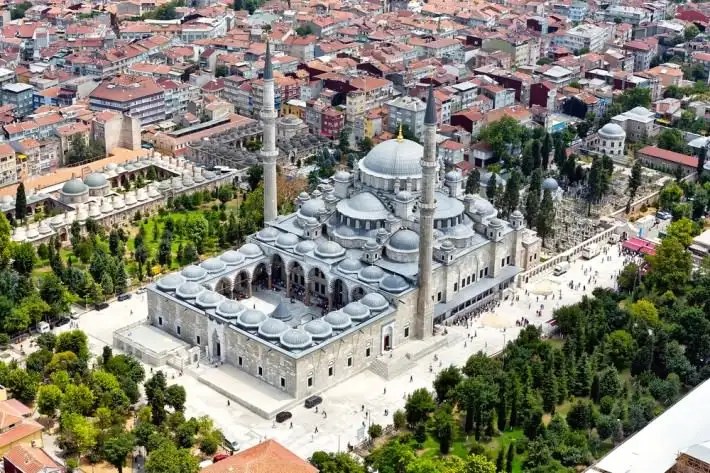
Mimar Koca Sinan’s masterpiece—and his burial place—is the Mosque of Süleyman (1550–57), inspired by, but not copied from, Hagia Sophia. It ranks as another of the world’s great buildings. Probably the most popularly known of all the mosques in Istanbul is the Blue Mosque, which has six minarets instead of the customary four.
 D. Kauten's Travel Blog